


Cart
Your shopping cart is empty
Continue Shopping
Every Order, Backed by HBADA
30-day in-home Trial
Free Delivery in 3–5 Business Days
5-Year Hassle-Free Warranty
24/7 Customer Support
Remove this item from your cart?
Cart
 How Long Do Office Chairs Last? Durability Tests Explained
The everyday durability guide
A lasting chair starts with more than a number.
Before buying an office chair, it is natural to ask: “Will this actually hold up?” The useful answer comes from understanding its components, how you use it, and what happens when a part needs attention.
Quick answer
Office chairs do not have one universal lifespan. Materials, construction, daily use, user load, maintenance, and access to replacement parts all affect how long a chair remains useful. Component tests help explain durability, but they do not guarantee a specific number of years. Consider repair for an isolated, serviceable problem; consider replacement when safety, fit, or several major components can no longer be restored.
Inside this guide
How long should a chair last?
Cycles are not hours
What affects lifespan?
Understanding durability tests
Signs of wear
Repair or replace?
Making your chair last
Common questions
The buying takeaway
01 / THE REAL ANSWER
How long should an office chair last?
A chair’s age tells only part of its story. A lightly used home-office chair and a shared chair used across multiple shifts can accumulate very different amounts of wear in the same calendar year.
Rather than treating a general lifespan estimate as a replacement deadline, look at whether the chair remains stable, holds its adjustments, and supports your working position. A chair may still be usable after a replaceable component wears out. Conversely, a newer chair may need attention if it develops a structural or mechanical fault.
Three different things: a warranty describes coverage under stated terms; a durability test measures performance under a defined procedure; service life describes how long the chair remains usable in practice. These are not interchangeable.
When exploring HBADA ergonomic office chairs , review the specifications and service information for the exact model and configuration available in your delivery country.
02 / TESTING WITHOUT THE GUESSWORK
Why test cycles cannot simply become hours of use
Durability testing can repeat a defined action, such as rotating a seat or operating a reclining mechanism, under controlled conditions. The resulting cycle count describes that test—not a complete record of everyday ownership.
One person may recline frequently, while another stays mostly upright. Loads, movement patterns, cleaning habits, and the surrounding environment also differ. There is no universal conversion from a component cycle count to “hours of sitting” or “years before replacement”.
About a “1,000-hour test”: an actual time-based test needs a documented method and recorded observations. Component cycle counts alone cannot establish that a chair has completed 1,000 hours of real-world testing.
Use laboratory figures as one part of your assessment, alongside fit, serviceability, warranty terms, and the information available about the test itself.
03 / WHAT MAKES THE DIFFERENCE
What affects ergonomic office chair lifespan?
Durability is not just about the seat surface. A chair is a system of moving and load-bearing parts, and the condition of each one matters.
Construction and components
The base, frame, lift, reclining mechanism, and attachment points all contribute to how the chair handles everyday use. Check the specifications of the exact model rather than relying on appearance alone.
Seat and back materials
Mesh, fabric, foam, and other upholstery materials wear differently. Check for changes in support, tension, seams, and attachment points—not just cosmetic marks.
How the chair is used
Shared use, frequent adjustments, repeated reclining, and loads outside the stated limits can change the demands placed on a chair.
Care and repair options
Appropriate cleaning and timely attention to loose or worn parts help maintain usability. Available, compatible replacement parts can also make repair more practical.
04 / READING THE EVIDENCE
What office chair durability tests actually tell you
A useful test claim identifies the component being assessed. A lift test, for example, does not establish how long the mesh will retain its tension. Likewise, a rotation test does not measure every part of the chair.
Read each test within its stated scope
Test area
What to check
What not to assume
Armrests
The tested movement or load, cycle count, and pass criteria.
That the result guarantees the same lifespan for the seat or backrest.
Gas lift
The lift test procedure and the model or component it applies to.
That lift cycles measure mesh durability or predict a fixed number of years.
Rotation
The stated rotation procedure, loading, and test conditions.
That rotation cycles equal hours spent sitting.
Reclining mechanism
The tested movement, applied load, and assessment criteria.
That the mechanism cannot develop a fault under different conditions.
Look beyond the headline cycle count
When comparing test claims, ask which part was tested, what load was applied, how the movement was defined, and what counted as passing. Two large numbers are not necessarily comparable if the procedures differ.
If a listing mentions a testing standard or certification, look for documentation that identifies the exact model and scope. A brief product-page statement is not a substitute for a full test report.
Check the version you are buying. Do not assume that a test figure shown for a different model, configuration, or regional listing automatically applies to the chair in your basket.
05 / NOTICE THE CHANGES
Signs of office chair wear and tear to watch for
Pay attention to changes in how the chair behaves. Surface wear may be cosmetic; instability or a mechanism that no longer holds its position deserves closer attention.
The seat no longer holds its height. Check with support whether the lift or another component needs service.
The chair feels unstable. New wobbling, a damaged base, or visible cracks should be assessed before continued use.
The seat or back has lost support. Look for persistent sagging, damaged seams, or attachment points pulling away.
An adjustment no longer stays in place. A slipping backrest or failed locking mechanism can change your sitting position unexpectedly.
Several faults are developing together. Consider the condition of the whole chair instead of evaluating each repair in isolation.
Do not judge a problem by sound alone. A squeak may have a straightforward cause, but a new noise accompanied by looseness, cracks, or unexpected movement needs investigation. Stop using a chair that appears structurally unsafe.
New discomfort is also a reason to reassess your chair settings and workstation. It does not, by itself, prove that the chair is worn out or identify a medical cause.
06 / THE PRACTICAL DECISION
When should you repair or replace an office chair?
Start with the fault, not the chair’s birthday. An isolated problem may be repairable if the rest of the chair is sound and an approved replacement part is available.
Repair or replace: questions to guide your decision
Situation
Suggested next step
One worn, replaceable component
Ask about compatible parts, coverage, and the recommended repair procedure.
Loose fasteners without visible damage
Follow the assembly instructions or ask support how to inspect and secure the connection.
Cracked or damaged load-bearing structure
Stop using the chair and seek assessment. Do not attempt an improvised structural repair.
Several major parts need replacement
Compare the complete repair cost, parts availability, and remaining condition with replacement.
The chair no longer fits your needs
Recheck adjustments first. Consider a different chair if its adjustment range cannot provide a suitable fit.
What about a chair that keeps sinking?
A sinking seat can indicate a problem with the gas lift, but the cause and compatible replacement should be confirmed with the manufacturer. Ask for a repair quote before assuming the entire chair must be replaced.
Do not open, drill, heat, or modify a gas cylinder. Use manufacturer-approved service guidance and seek professional help when necessary.
Compare the complete repair cost
Consider the replacement part, delivery, any installation charge, and the condition of the remaining components. Check availability for your delivery country rather than relying on a price quoted for another market.
Keep your order details, model information, and clear photographs of the issue ready when contacting the seller or manufacturer.
07 / SMALL HABITS, USEFUL UPKEEP
How to help your office chair last longer
Good care does not make a chair indestructible, but it can help you identify problems early and avoid preventable damage.
Follow the care instructions for your model. Use cleaning methods suited to its materials. Avoid applying a leather treatment or strong cleaning product to a surface it is not intended for.
Keep castors clear. Remove accessible hair and debris as directed, and check that the wheels remain securely attached.
Check connections when something changes. Investigate new looseness or movement. Tighten fasteners only as instructed; overtightening can cause damage.
Stay within the stated operating limits. Follow the chair’s load and use instructions. Do not stand on the seat or force an adjustment past its stop.
Address small faults before they spread. Contact support when a mechanism stops working normally rather than compensating with an awkward sitting position.
Keep service information accessible. Save the manual and purchase details so that checking coverage or identifying a replacement part is easier.
08 / COMMON QUESTIONS
Office chair lifespan FAQs
Should I replace my office chair after five years?
Not automatically. Assess its stability, adjustment mechanisms, seat support, and suitability for your workstation. Age alone is not a reliable replacement rule.
Do higher test-cycle numbers mean a chair lasts longer?
They can provide useful information about a tested component, but only in the context of the procedure, load, and pass criteria. They do not establish a universal lifespan or make different test methods directly comparable.
Does a long warranty guarantee the same service life?
No. Warranty coverage depends on its terms, exclusions, and covered components. It is different from a prediction of how long a chair will remain comfortable and functional in your particular setting.
Can a sinking office chair be repaired?
It may be repairable if the cause is identified and a compatible replacement component is available. Contact the manufacturer for guidance. Do not dismantle or modify the gas cylinder itself.
Does mesh always wear out before a padded seat?
Material type alone cannot answer that question. Construction, material quality, loading, and care all matter. Inspect mesh for loss of tension or attachment damage and padded seats for lasting compression or other changes in support.
What should I check when ordering an office chair in Europe?
Check the exact model and configuration, fit and adjustment range, stated load limit, delivery availability, service terms, and replacement-part options for your country. Do not assume that details from another regional store apply to your order.
09 / THE TAKEAWAY
Buy for support, serviceability, and everyday use
The most useful durability question is not simply “How many years will it last?” It is “What evidence is available, does this chair fit my needs, and can I get help if something wears out?”
Read component figures in context, keep up with appropriate care, and assess faults early. That gives you a more practical basis for choosing and maintaining a chair than an unsupported lifespan promise.
Explore HBADA Europe
Find the right fit for your everyday workspace.
Explore HBADA’s European range and compare the specifications of the models that suit your workspace. Review adjustment options, delivery availability, and service information before choosing.
Explore HBADA Europe →
Enjoyed this guide? Stay connected with HBADA.
Make HBADA Europe one of your preferred sources on Google for more ergonomic chair guides, workspace tips, and practical advice.
Add HBADA Europe as a preferred source ↗
Opens Google in a new tab. Confirm your selection there if HBADA Europe is available.
Back to top ↑
Oct 19, 2026
How Long Do Office Chairs Last? Durability Tests Explained
The everyday durability guide
A lasting chair starts with more than a number.
Before buying an office chair, it is natural to ask: “Will this actually hold up?” The useful answer comes from understanding its components, how you use it, and what happens when a part needs attention.
Quick answer
Office chairs do not have one universal lifespan. Materials, construction, daily use, user load, maintenance, and access to replacement parts all affect how long a chair remains useful. Component tests help explain durability, but they do not guarantee a specific number of years. Consider repair for an isolated, serviceable problem; consider replacement when safety, fit, or several major components can no longer be restored.
Inside this guide
How long should a chair last?
Cycles are not hours
What affects lifespan?
Understanding durability tests
Signs of wear
Repair or replace?
Making your chair last
Common questions
The buying takeaway
01 / THE REAL ANSWER
How long should an office chair last?
A chair’s age tells only part of its story. A lightly used home-office chair and a shared chair used across multiple shifts can accumulate very different amounts of wear in the same calendar year.
Rather than treating a general lifespan estimate as a replacement deadline, look at whether the chair remains stable, holds its adjustments, and supports your working position. A chair may still be usable after a replaceable component wears out. Conversely, a newer chair may need attention if it develops a structural or mechanical fault.
Three different things: a warranty describes coverage under stated terms; a durability test measures performance under a defined procedure; service life describes how long the chair remains usable in practice. These are not interchangeable.
When exploring HBADA ergonomic office chairs , review the specifications and service information for the exact model and configuration available in your delivery country.
02 / TESTING WITHOUT THE GUESSWORK
Why test cycles cannot simply become hours of use
Durability testing can repeat a defined action, such as rotating a seat or operating a reclining mechanism, under controlled conditions. The resulting cycle count describes that test—not a complete record of everyday ownership.
One person may recline frequently, while another stays mostly upright. Loads, movement patterns, cleaning habits, and the surrounding environment also differ. There is no universal conversion from a component cycle count to “hours of sitting” or “years before replacement”.
About a “1,000-hour test”: an actual time-based test needs a documented method and recorded observations. Component cycle counts alone cannot establish that a chair has completed 1,000 hours of real-world testing.
Use laboratory figures as one part of your assessment, alongside fit, serviceability, warranty terms, and the information available about the test itself.
03 / WHAT MAKES THE DIFFERENCE
What affects ergonomic office chair lifespan?
Durability is not just about the seat surface. A chair is a system of moving and load-bearing parts, and the condition of each one matters.
Construction and components
The base, frame, lift, reclining mechanism, and attachment points all contribute to how the chair handles everyday use. Check the specifications of the exact model rather than relying on appearance alone.
Seat and back materials
Mesh, fabric, foam, and other upholstery materials wear differently. Check for changes in support, tension, seams, and attachment points—not just cosmetic marks.
How the chair is used
Shared use, frequent adjustments, repeated reclining, and loads outside the stated limits can change the demands placed on a chair.
Care and repair options
Appropriate cleaning and timely attention to loose or worn parts help maintain usability. Available, compatible replacement parts can also make repair more practical.
04 / READING THE EVIDENCE
What office chair durability tests actually tell you
A useful test claim identifies the component being assessed. A lift test, for example, does not establish how long the mesh will retain its tension. Likewise, a rotation test does not measure every part of the chair.
Read each test within its stated scope
Test area
What to check
What not to assume
Armrests
The tested movement or load, cycle count, and pass criteria.
That the result guarantees the same lifespan for the seat or backrest.
Gas lift
The lift test procedure and the model or component it applies to.
That lift cycles measure mesh durability or predict a fixed number of years.
Rotation
The stated rotation procedure, loading, and test conditions.
That rotation cycles equal hours spent sitting.
Reclining mechanism
The tested movement, applied load, and assessment criteria.
That the mechanism cannot develop a fault under different conditions.
Look beyond the headline cycle count
When comparing test claims, ask which part was tested, what load was applied, how the movement was defined, and what counted as passing. Two large numbers are not necessarily comparable if the procedures differ.
If a listing mentions a testing standard or certification, look for documentation that identifies the exact model and scope. A brief product-page statement is not a substitute for a full test report.
Check the version you are buying. Do not assume that a test figure shown for a different model, configuration, or regional listing automatically applies to the chair in your basket.
05 / NOTICE THE CHANGES
Signs of office chair wear and tear to watch for
Pay attention to changes in how the chair behaves. Surface wear may be cosmetic; instability or a mechanism that no longer holds its position deserves closer attention.
The seat no longer holds its height. Check with support whether the lift or another component needs service.
The chair feels unstable. New wobbling, a damaged base, or visible cracks should be assessed before continued use.
The seat or back has lost support. Look for persistent sagging, damaged seams, or attachment points pulling away.
An adjustment no longer stays in place. A slipping backrest or failed locking mechanism can change your sitting position unexpectedly.
Several faults are developing together. Consider the condition of the whole chair instead of evaluating each repair in isolation.
Do not judge a problem by sound alone. A squeak may have a straightforward cause, but a new noise accompanied by looseness, cracks, or unexpected movement needs investigation. Stop using a chair that appears structurally unsafe.
New discomfort is also a reason to reassess your chair settings and workstation. It does not, by itself, prove that the chair is worn out or identify a medical cause.
06 / THE PRACTICAL DECISION
When should you repair or replace an office chair?
Start with the fault, not the chair’s birthday. An isolated problem may be repairable if the rest of the chair is sound and an approved replacement part is available.
Repair or replace: questions to guide your decision
Situation
Suggested next step
One worn, replaceable component
Ask about compatible parts, coverage, and the recommended repair procedure.
Loose fasteners without visible damage
Follow the assembly instructions or ask support how to inspect and secure the connection.
Cracked or damaged load-bearing structure
Stop using the chair and seek assessment. Do not attempt an improvised structural repair.
Several major parts need replacement
Compare the complete repair cost, parts availability, and remaining condition with replacement.
The chair no longer fits your needs
Recheck adjustments first. Consider a different chair if its adjustment range cannot provide a suitable fit.
What about a chair that keeps sinking?
A sinking seat can indicate a problem with the gas lift, but the cause and compatible replacement should be confirmed with the manufacturer. Ask for a repair quote before assuming the entire chair must be replaced.
Do not open, drill, heat, or modify a gas cylinder. Use manufacturer-approved service guidance and seek professional help when necessary.
Compare the complete repair cost
Consider the replacement part, delivery, any installation charge, and the condition of the remaining components. Check availability for your delivery country rather than relying on a price quoted for another market.
Keep your order details, model information, and clear photographs of the issue ready when contacting the seller or manufacturer.
07 / SMALL HABITS, USEFUL UPKEEP
How to help your office chair last longer
Good care does not make a chair indestructible, but it can help you identify problems early and avoid preventable damage.
Follow the care instructions for your model. Use cleaning methods suited to its materials. Avoid applying a leather treatment or strong cleaning product to a surface it is not intended for.
Keep castors clear. Remove accessible hair and debris as directed, and check that the wheels remain securely attached.
Check connections when something changes. Investigate new looseness or movement. Tighten fasteners only as instructed; overtightening can cause damage.
Stay within the stated operating limits. Follow the chair’s load and use instructions. Do not stand on the seat or force an adjustment past its stop.
Address small faults before they spread. Contact support when a mechanism stops working normally rather than compensating with an awkward sitting position.
Keep service information accessible. Save the manual and purchase details so that checking coverage or identifying a replacement part is easier.
08 / COMMON QUESTIONS
Office chair lifespan FAQs
Should I replace my office chair after five years?
Not automatically. Assess its stability, adjustment mechanisms, seat support, and suitability for your workstation. Age alone is not a reliable replacement rule.
Do higher test-cycle numbers mean a chair lasts longer?
They can provide useful information about a tested component, but only in the context of the procedure, load, and pass criteria. They do not establish a universal lifespan or make different test methods directly comparable.
Does a long warranty guarantee the same service life?
No. Warranty coverage depends on its terms, exclusions, and covered components. It is different from a prediction of how long a chair will remain comfortable and functional in your particular setting.
Can a sinking office chair be repaired?
It may be repairable if the cause is identified and a compatible replacement component is available. Contact the manufacturer for guidance. Do not dismantle or modify the gas cylinder itself.
Does mesh always wear out before a padded seat?
Material type alone cannot answer that question. Construction, material quality, loading, and care all matter. Inspect mesh for loss of tension or attachment damage and padded seats for lasting compression or other changes in support.
What should I check when ordering an office chair in Europe?
Check the exact model and configuration, fit and adjustment range, stated load limit, delivery availability, service terms, and replacement-part options for your country. Do not assume that details from another regional store apply to your order.
09 / THE TAKEAWAY
Buy for support, serviceability, and everyday use
The most useful durability question is not simply “How many years will it last?” It is “What evidence is available, does this chair fit my needs, and can I get help if something wears out?”
Read component figures in context, keep up with appropriate care, and assess faults early. That gives you a more practical basis for choosing and maintaining a chair than an unsupported lifespan promise.
Explore HBADA Europe
Find the right fit for your everyday workspace.
Explore HBADA’s European range and compare the specifications of the models that suit your workspace. Review adjustment options, delivery availability, and service information before choosing.
Explore HBADA Europe →
Enjoyed this guide? Stay connected with HBADA.
Make HBADA Europe one of your preferred sources on Google for more ergonomic chair guides, workspace tips, and practical advice.
Add HBADA Europe as a preferred source ↗
Opens Google in a new tab. Confirm your selection there if HBADA Europe is available.
Back to top ↑
Oct 19, 2026
 Do Mesh Office Chairs Sag? A 180-Day Durability Check Guide
Materials, comfort & everyday care
A little flex is normal.A lasting dip deserves a closer look.
Understand why mesh can lose tension, what durability testing actually tells you, and how to track changes during your first six months of use.
Quick answer
Yes, mesh office chairs can sag, but it is not an inevitable outcome for every chair. Material, construction, attachment points, loading, and care all matter. Normal flex under your weight is different from a persistent change in shape or support.
This is a durability and inspection guide, not a report of a completed 180-day wear test. Laboratory cycle counts are not converted into promised months or years of use.
In this guide
Ask the better question
How mesh sagging happens
Lab cycles and a 180-day check
What testing can show
How to compare mesh quality
Signs to watch for
Mesh care and lifespan
Warranty and support
Frequently asked questions
Final thoughts
01 / START WITH THE RIGHT QUESTION
Why “Do Mesh Office Chairs Sag?” Is Only the Starting Point
If you have ever sat in a mesh chair that felt firm at first and noticeably softer later, you already understand the concern. But treating “mesh” as one uniform material can make the comparison misleading.
Two chairs can look similar in a photo while using different fibres, weave structures, initial tension, and frame attachments. Those details influence how the seating surface responds to repeated use.
Instead of asking only whether mesh sags, ask what evidence supports the durability of the specific seat or backrest you are considering.
Look at the complete construction. Mesh quality matters, but so do the frame, attachment system, intended loading, and how the chair is used. Price or appearance alone cannot establish lifespan.
02 / FLEX VERSUS LASTING CHANGE
How Mesh Sagging Actually Happens
A mesh seat is designed to deflect under load. When you sit down, the material and supporting structure accommodate your weight. When the load is removed, the surface should recover in line with its design.
Over time, material stretching, damage, or movement at attachment points can change the unloaded shape or the support you feel. The cause is not always the fabric itself: frame or fastening problems can produce a similar symptom.
Designed movement
Normal flex
The surface moves under your weight and returns towards its original contour after you stand. A curved seat is not automatically a sagging seat.
A change to investigate
Persistent sagging
A new dip remains when the chair is unloaded, the surface feels progressively less supportive, or an edge appears loose compared with its original condition.
A change in support may affect how you sit or create uncomfortable contact with the frame. It does not establish a specific medical problem, but it is a reason to inspect the chair and seek product support.
03 / WHAT SIX MONTHS CAN TELL YOU
Turning Lab Cycles Into a Real Timeline: What You Can—and Cannot—Do
Repeated-load tests help assess how a component performs under defined conditions. Their value depends on the tested part, load, contact area, procedure, and pass criteria.
A cycle count alone cannot be translated into 180 days or several years of ordinary use. Daily sitting includes sustained loading, shifting positions, different body weights, and environmental conditions that a single test may not reproduce.
A more practical approach is to record your own chair's condition consistently. The following is a suggested inspection schedule—not measured test results or a prediction of when wear will appear.
Checkpoint
What to record
Why it helps
Day 1
Photograph the unloaded seat and backrest, including their edges. Note the chair settings and initial support feel.
Establishes a baseline rather than relying on memory.
Around Day 30
Check for new persistent indentations, loose edges, or changes in support.
Helps identify an early issue to discuss with support.
Around Day 90
Repeat photographs from the same angles and inspect attachment areas.
Makes gradual changes easier to compare.
Around Day 180
Compare the unloaded contour, visible condition, and support feel with the original record.
Creates a useful six-month condition history.
Use similar lighting, chair settings, and time after unloading for each comparison. Do not wait for a scheduled checkpoint if the mesh tears, detaches, or the chair feels unstable.
04 / READ THE EVIDENCE
What High-Tensile Mesh Testing Shows
A useful mesh test explains what was measured. Tensile strength, permanent deformation, repeated-load performance, and attachment durability are related questions, but they are not interchangeable results.
Strength retention does not automatically establish that a seat will retain exactly the same shape or feel. Likewise, a high cycle count for a different chair component does not demonstrate mesh durability.
Tested item: Was it a fabric sample, a complete mesh seat, or another component?
Test conditions: What load, contact area, and procedure were used?
Measured result: Was the result strength retention, deformation, damage, or simply completion of the test?
Product match: Does the report apply to the exact model and material being sold?
Keep component results separate. A test for a gas lift, armrest, or rotation mechanism cannot be relabelled as a mesh tension test. Ask for evidence that relates to the material or assembly you want to evaluate.
05 / COMPARE WITHOUT GUESSING
Mesh Quality and Expected Lifespan: What to Compare
There is no dependable universal timetable that assigns “a few months” to budget mesh or “several years” to premium mesh. Without comparable evidence, those categories are descriptions—not lifespan measurements.
Information provided
What it helps you assess
What it does not establish
Material and weave description
How the mesh is constructed and positioned in the product range.
A precise time before sagging.
Mesh-specific test report
Performance of the tested material or assembly under stated conditions.
Identical results for every user or a different model.
General chair testing
Results for the components and procedures actually included.
A direct measurement of mesh lifespan unless the relevant test is documented.
Warranty terms
Available support for eligible problems and the applicable exclusions.
A promise that the mesh will never change or wear.
If a product uses a named mesh material, ask which model uses it and what evidence relates to that construction. A material name alone is not a substitute for a relevant test.
06 / KNOW WHAT TO LOOK FOR
What to Watch For as a Chair Ages
Compare the chair with its original condition rather than expecting every mesh surface to look completely flat. Look for a combination of visible changes and differences in support.
A new dip that remains in the unloaded seat or backrest.
A noticeable reduction in recovery compared with earlier checks.
A persistent change in support at the same chair settings.
Fraying, broken strands, or separation at an attachment point.
New contact with a hard frame edge beneath or beside the mesh.
Do not diagnose every change as worn mesh. Check whether seat settings, a loose component, or the backrest position changed. If the material is torn, detached, or no longer supports you safely, stop using the chair and contact the manufacturer.
07 / EVERYDAY CARE
Mesh Office Chair Durability: How to Care for the Mesh
Good care can reduce avoidable damage, although it cannot guarantee a fixed lifespan or reverse material wear. Follow the instructions supplied for your chair.
Use the chair as intended. Stay within the specified load limit and do not stand or kneel on the mesh.
Avoid concentrated loads. Do not store heavy or sharp-edged objects on the seat or backrest.
Protect the surface. Keep sharp objects and direct heat sources away from the mesh.
Clean gently. Where permitted by the care instructions, use a soft cloth or a vacuum with a soft brush attachment.
Check before using cleaners. Avoid unapproved solvents, abrasive tools, or heat-based cleaning methods.
Leave loose strands alone. Photograph the issue and ask support for guidance rather than pulling, cutting, or trying to retension the material.
DIY heating or tightening can damage the fabric or its attachment system. Use only a repair or adjustment procedure specifically approved for the model.
08 / IF SOMETHING CHANGES
What's Covered If Your Mesh Does Sag?
Coverage depends on the applicable terms, the affected component, and the cause of the problem. Do not assume every change in tension is automatically covered—or that a problem is merely normal wear without having it assessed.
For a purchase from HBADA's European store, use the support and warranty information available through the HBADA Europe website and the documentation supplied with your order. Do not substitute US-store terms for the terms applicable to your purchase.
Prepare a clear support request
Your order number, purchase date, delivery country, and exact model.
Photos of the whole chair and close-ups of the affected area.
When you first noticed the change and whether it is progressing.
A description of the issue, including whether it remains when unloaded.
Any baseline photos that show the original condition.
Ask the support team to confirm the next step and any available repair or replacement options. Avoid modifying the seat before receiving model-specific guidance.
09 / QUICK ANSWERS
Frequently Asked Questions
Do mesh office chairs sag more than foam chairs?
There is no universal answer. Mesh can lose tension, while foam can compress or change shape. Compare the specific construction, supporting evidence, and usage conditions rather than judging durability by material category alone.
How long does chair mesh last before it starts to sag?
There is no single reliable timetable. Material, construction, loading, environment, and care all affect wear. A cycle count without a validated relationship to real-world use cannot establish a lifespan in years.
What does a mesh chair wear test actually measure?
It depends on the procedure. A test may evaluate repeated loading, permanent deformation, damage, or retained material strength. Check what was tested and how the result was measured before comparing numbers.
Can I fix mesh that has already sagged?
That depends on the cause and chair design. Do not assume the mesh can be safely tightened or restored with heat. Contact the manufacturer for an approved adjustment, repair, or replacement procedure.
Is CloudMesh more durable than other mesh?
A reliable comparison needs model-specific material information and comparable test results. The CloudMesh name alone does not establish a particular lifespan or prove superiority over every other mesh construction.
What's the fastest way to check whether my mesh is sagging?
Compare the unloaded surface with a baseline photo. Look for a new lasting dip, loose edges, damaged strands, or a consistent change in support at the same settings. Normal flex while seated is not automatically a defect.
10 / THE TAKEAWAY
The Mesh Is Only as Good as What's Behind It
The answer to “Do mesh office chairs sag?” is not a simple yes or no. The useful questions concern construction, relevant testing, loading, and how the chair changes over time.
When shopping, look beyond the word “mesh.” Check the exact model, supported use, available evidence, and service options. Once the chair arrives, a few consistent condition checks are more useful than assuming any test number guarantees years of unchanged support.
Find your fit
Choose the whole chair—not just the mesh.
Explore HBADA's ergonomic office chairs and compare seat dimensions, adjustment options, materials, and care information for your workspace.
Explore HBADA X7 →
Enjoyed this guide? Stay connected with HBADA.
Make HBADA one of your preferred sources on Google for more ergonomic chair guides, workspace tips, and practical advice.
Add HBADA as a preferred source on Google ↗
Opens Google in a new tab. Confirm your selection there if HBADA is available.
Back to top ↑
Oct 15, 2026
Do Mesh Office Chairs Sag? A 180-Day Durability Check Guide
Materials, comfort & everyday care
A little flex is normal.A lasting dip deserves a closer look.
Understand why mesh can lose tension, what durability testing actually tells you, and how to track changes during your first six months of use.
Quick answer
Yes, mesh office chairs can sag, but it is not an inevitable outcome for every chair. Material, construction, attachment points, loading, and care all matter. Normal flex under your weight is different from a persistent change in shape or support.
This is a durability and inspection guide, not a report of a completed 180-day wear test. Laboratory cycle counts are not converted into promised months or years of use.
In this guide
Ask the better question
How mesh sagging happens
Lab cycles and a 180-day check
What testing can show
How to compare mesh quality
Signs to watch for
Mesh care and lifespan
Warranty and support
Frequently asked questions
Final thoughts
01 / START WITH THE RIGHT QUESTION
Why “Do Mesh Office Chairs Sag?” Is Only the Starting Point
If you have ever sat in a mesh chair that felt firm at first and noticeably softer later, you already understand the concern. But treating “mesh” as one uniform material can make the comparison misleading.
Two chairs can look similar in a photo while using different fibres, weave structures, initial tension, and frame attachments. Those details influence how the seating surface responds to repeated use.
Instead of asking only whether mesh sags, ask what evidence supports the durability of the specific seat or backrest you are considering.
Look at the complete construction. Mesh quality matters, but so do the frame, attachment system, intended loading, and how the chair is used. Price or appearance alone cannot establish lifespan.
02 / FLEX VERSUS LASTING CHANGE
How Mesh Sagging Actually Happens
A mesh seat is designed to deflect under load. When you sit down, the material and supporting structure accommodate your weight. When the load is removed, the surface should recover in line with its design.
Over time, material stretching, damage, or movement at attachment points can change the unloaded shape or the support you feel. The cause is not always the fabric itself: frame or fastening problems can produce a similar symptom.
Designed movement
Normal flex
The surface moves under your weight and returns towards its original contour after you stand. A curved seat is not automatically a sagging seat.
A change to investigate
Persistent sagging
A new dip remains when the chair is unloaded, the surface feels progressively less supportive, or an edge appears loose compared with its original condition.
A change in support may affect how you sit or create uncomfortable contact with the frame. It does not establish a specific medical problem, but it is a reason to inspect the chair and seek product support.
03 / WHAT SIX MONTHS CAN TELL YOU
Turning Lab Cycles Into a Real Timeline: What You Can—and Cannot—Do
Repeated-load tests help assess how a component performs under defined conditions. Their value depends on the tested part, load, contact area, procedure, and pass criteria.
A cycle count alone cannot be translated into 180 days or several years of ordinary use. Daily sitting includes sustained loading, shifting positions, different body weights, and environmental conditions that a single test may not reproduce.
A more practical approach is to record your own chair's condition consistently. The following is a suggested inspection schedule—not measured test results or a prediction of when wear will appear.
Checkpoint
What to record
Why it helps
Day 1
Photograph the unloaded seat and backrest, including their edges. Note the chair settings and initial support feel.
Establishes a baseline rather than relying on memory.
Around Day 30
Check for new persistent indentations, loose edges, or changes in support.
Helps identify an early issue to discuss with support.
Around Day 90
Repeat photographs from the same angles and inspect attachment areas.
Makes gradual changes easier to compare.
Around Day 180
Compare the unloaded contour, visible condition, and support feel with the original record.
Creates a useful six-month condition history.
Use similar lighting, chair settings, and time after unloading for each comparison. Do not wait for a scheduled checkpoint if the mesh tears, detaches, or the chair feels unstable.
04 / READ THE EVIDENCE
What High-Tensile Mesh Testing Shows
A useful mesh test explains what was measured. Tensile strength, permanent deformation, repeated-load performance, and attachment durability are related questions, but they are not interchangeable results.
Strength retention does not automatically establish that a seat will retain exactly the same shape or feel. Likewise, a high cycle count for a different chair component does not demonstrate mesh durability.
Tested item: Was it a fabric sample, a complete mesh seat, or another component?
Test conditions: What load, contact area, and procedure were used?
Measured result: Was the result strength retention, deformation, damage, or simply completion of the test?
Product match: Does the report apply to the exact model and material being sold?
Keep component results separate. A test for a gas lift, armrest, or rotation mechanism cannot be relabelled as a mesh tension test. Ask for evidence that relates to the material or assembly you want to evaluate.
05 / COMPARE WITHOUT GUESSING
Mesh Quality and Expected Lifespan: What to Compare
There is no dependable universal timetable that assigns “a few months” to budget mesh or “several years” to premium mesh. Without comparable evidence, those categories are descriptions—not lifespan measurements.
Information provided
What it helps you assess
What it does not establish
Material and weave description
How the mesh is constructed and positioned in the product range.
A precise time before sagging.
Mesh-specific test report
Performance of the tested material or assembly under stated conditions.
Identical results for every user or a different model.
General chair testing
Results for the components and procedures actually included.
A direct measurement of mesh lifespan unless the relevant test is documented.
Warranty terms
Available support for eligible problems and the applicable exclusions.
A promise that the mesh will never change or wear.
If a product uses a named mesh material, ask which model uses it and what evidence relates to that construction. A material name alone is not a substitute for a relevant test.
06 / KNOW WHAT TO LOOK FOR
What to Watch For as a Chair Ages
Compare the chair with its original condition rather than expecting every mesh surface to look completely flat. Look for a combination of visible changes and differences in support.
A new dip that remains in the unloaded seat or backrest.
A noticeable reduction in recovery compared with earlier checks.
A persistent change in support at the same chair settings.
Fraying, broken strands, or separation at an attachment point.
New contact with a hard frame edge beneath or beside the mesh.
Do not diagnose every change as worn mesh. Check whether seat settings, a loose component, or the backrest position changed. If the material is torn, detached, or no longer supports you safely, stop using the chair and contact the manufacturer.
07 / EVERYDAY CARE
Mesh Office Chair Durability: How to Care for the Mesh
Good care can reduce avoidable damage, although it cannot guarantee a fixed lifespan or reverse material wear. Follow the instructions supplied for your chair.
Use the chair as intended. Stay within the specified load limit and do not stand or kneel on the mesh.
Avoid concentrated loads. Do not store heavy or sharp-edged objects on the seat or backrest.
Protect the surface. Keep sharp objects and direct heat sources away from the mesh.
Clean gently. Where permitted by the care instructions, use a soft cloth or a vacuum with a soft brush attachment.
Check before using cleaners. Avoid unapproved solvents, abrasive tools, or heat-based cleaning methods.
Leave loose strands alone. Photograph the issue and ask support for guidance rather than pulling, cutting, or trying to retension the material.
DIY heating or tightening can damage the fabric or its attachment system. Use only a repair or adjustment procedure specifically approved for the model.
08 / IF SOMETHING CHANGES
What's Covered If Your Mesh Does Sag?
Coverage depends on the applicable terms, the affected component, and the cause of the problem. Do not assume every change in tension is automatically covered—or that a problem is merely normal wear without having it assessed.
For a purchase from HBADA's European store, use the support and warranty information available through the HBADA Europe website and the documentation supplied with your order. Do not substitute US-store terms for the terms applicable to your purchase.
Prepare a clear support request
Your order number, purchase date, delivery country, and exact model.
Photos of the whole chair and close-ups of the affected area.
When you first noticed the change and whether it is progressing.
A description of the issue, including whether it remains when unloaded.
Any baseline photos that show the original condition.
Ask the support team to confirm the next step and any available repair or replacement options. Avoid modifying the seat before receiving model-specific guidance.
09 / QUICK ANSWERS
Frequently Asked Questions
Do mesh office chairs sag more than foam chairs?
There is no universal answer. Mesh can lose tension, while foam can compress or change shape. Compare the specific construction, supporting evidence, and usage conditions rather than judging durability by material category alone.
How long does chair mesh last before it starts to sag?
There is no single reliable timetable. Material, construction, loading, environment, and care all affect wear. A cycle count without a validated relationship to real-world use cannot establish a lifespan in years.
What does a mesh chair wear test actually measure?
It depends on the procedure. A test may evaluate repeated loading, permanent deformation, damage, or retained material strength. Check what was tested and how the result was measured before comparing numbers.
Can I fix mesh that has already sagged?
That depends on the cause and chair design. Do not assume the mesh can be safely tightened or restored with heat. Contact the manufacturer for an approved adjustment, repair, or replacement procedure.
Is CloudMesh more durable than other mesh?
A reliable comparison needs model-specific material information and comparable test results. The CloudMesh name alone does not establish a particular lifespan or prove superiority over every other mesh construction.
What's the fastest way to check whether my mesh is sagging?
Compare the unloaded surface with a baseline photo. Look for a new lasting dip, loose edges, damaged strands, or a consistent change in support at the same settings. Normal flex while seated is not automatically a defect.
10 / THE TAKEAWAY
The Mesh Is Only as Good as What's Behind It
The answer to “Do mesh office chairs sag?” is not a simple yes or no. The useful questions concern construction, relevant testing, loading, and how the chair changes over time.
When shopping, look beyond the word “mesh.” Check the exact model, supported use, available evidence, and service options. Once the chair arrives, a few consistent condition checks are more useful than assuming any test number guarantees years of unchanged support.
Find your fit
Choose the whole chair—not just the mesh.
Explore HBADA's ergonomic office chairs and compare seat dimensions, adjustment options, materials, and care information for your workspace.
Explore HBADA X7 →
Enjoyed this guide? Stay connected with HBADA.
Make HBADA one of your preferred sources on Google for more ergonomic chair guides, workspace tips, and practical advice.
Add HBADA as a preferred source on Google ↗
Opens Google in a new tab. Confirm your selection there if HBADA is available.
Back to top ↑
Oct 15, 2026
 What Is an AI Ergonomic Chair? Smart Features Explained
Smart seating, explained simply
What makes a chair smart?Start with how it responds.
Sensors, automatic lumbar support, and built-in comfort features: here is what the technology does—and what still depends on you.
Quick answer
An AI ergonomic chair typically uses sensors and electronic controls to automate selected adjustments, such as lumbar support. In a motorised tracking system, sensor inputs help the chair respond to changes in position. The exact functions vary by model, and the “AI” label alone does not tell you whether a chair uses machine learning.
In this guide
Beyond manual adjustment
What makes a chair “AI”?
How posture sensors work
Intelligent lumbar support
Smart vs. traditional chairs
Other smart features
Is it worth the price?
The HBADA X7 example
What “AI” really means
Frequently asked questions
Final thoughts
01 / A DIFFERENT KIND OF ADJUSTMENT
Not Just Another Chair With More Knobs
“AI chair” gets thrown around a lot these days, and it is fair to wonder what sits behind the label. The useful question is not simply whether a chair is called smart. It is which adjustments the chair makes for you.
A traditional ergonomic chair relies on you to set features such as seat height, armrest position, and lumbar support. Some also use flexible backrests or mechanical systems that respond as you move, so traditional does not necessarily mean static.
A chair with electronically controlled lumbar tracking adds another approach: it uses sensor feedback to adjust selected support features while the system is active.
The practical difference is automation. Instead of manually changing every support setting, you let the chair handle a specific adjustment within its operating range. You still need to set up the rest of your workstation.
02 / THE CORE TECHNOLOGY
What Actually Makes a Chair “AI”?
For a motorised lumbar-tracking chair, the basic idea is a feedback loop: sensors detect a physical change, a controller interprets the input, and a mechanism adjusts the support.
01. SenseDetect changes in pressure, contact, or component position.
02. ProcessUse the readings and selected settings to determine a response.
03. AdjustMove the support within the mechanism's available range.
This is different from simply adding more manual adjustment points. But sensors and motors alone do not establish how sophisticated the software is, whether it learns from use, or how well the chair will fit a particular person.
When comparing smart chairs, look for a clear explanation of the feature: what it senses, what it changes, and which settings you control.
03 / READING MOVEMENT
The Office Chair Posture Sensor Behind the Curtain
A posture-sensing system uses physical measurements rather than an understanding of your body in the human sense. Different designs may use pressure sensors, position sensors, or a combination of inputs.
Contact and load
Pressure sensors
Pressure readings can indicate changes in the force applied to a sensing area. The controller can use that information as one input when adjusting support.
Component position
Magnetic position sensors
Hall-effect sensors detect magnetic-field changes. Depending on the design, those changes can help track a mechanism's position rather than directly measure the shape of your spine.
The controller then uses the available information to guide a response. Exact sensor types, sampling rates, and movement speeds are model-specific specifications—not features to assume from the words “AI chair.”
A useful distinction: Sensor sampling frequency is not the same as the time needed for a motor to complete an adjustment. A fast reading does not, by itself, tell you how the movement will feel.
04 / FROM INPUT TO SUPPORT
Intelligent Lumbar Support, Explained Step by Step
In a sensor-driven, motorised lumbar system, the sequence can be understood in five steps:
You change position. Leaning or shifting changes your contact with the chair.
The system detects a change. Its sensors register the relevant pressure or position inputs.
The controller determines a response. The response depends on the system's programming, selected mode, and available settings.
The mechanism adjusts the lumbar support. Movement remains within the chair's designed travel range and operating limits.
The system continues monitoring. Further input can prompt another adjustment while the tracking function is active.
The goal is to reduce the need for repeated manual lumbar adjustments as your position changes. It does not mean the chair can maintain identical contact through every movement, correct every sitting position, or adjust every part of the chair automatically.
05 / SIDE BY SIDE
Smart Office Chair vs. Traditional Adjustable Chair
The distinction is best understood by comparing how the support works—not by assuming one category is always comfortable and the other is not.
Factor
Traditional adjustable chair
Smart chair with motorised lumbar tracking
Initial setup
You adjust the chair to fit your body and desk.
You still set up the chair, then select available electronic modes.
Lumbar adjustment
May be manual, flexible, or mechanically adaptive.
Uses electronic feedback to adjust selected lumbar functions.
Response to movement
Depends on the backrest, recline, and support mechanism.
Combines the chair's mechanical design with powered tracking.
User input
Manual controls and mechanical settings.
Manual setup plus powered controls or support preferences.
Power needs
A purely mechanical chair needs no charging.
Electronic functions need a suitable power source.
Cost
Varies widely by construction and adjustment features.
Added electronics may increase cost; compare actual models.
What to prioritise
Fit, adjustment range, support feel, and build quality.
The same fundamentals, plus tracking behaviour and electronic support.
06 / BEYOND TRACKING
Beyond the Lumbar: Other Smart Features to Know
Lumbar tracking tends to be the headline feature, but smart chairs may also include powered comfort functions. These should be assessed individually rather than treated as proof that the chair learns or understands your needs.
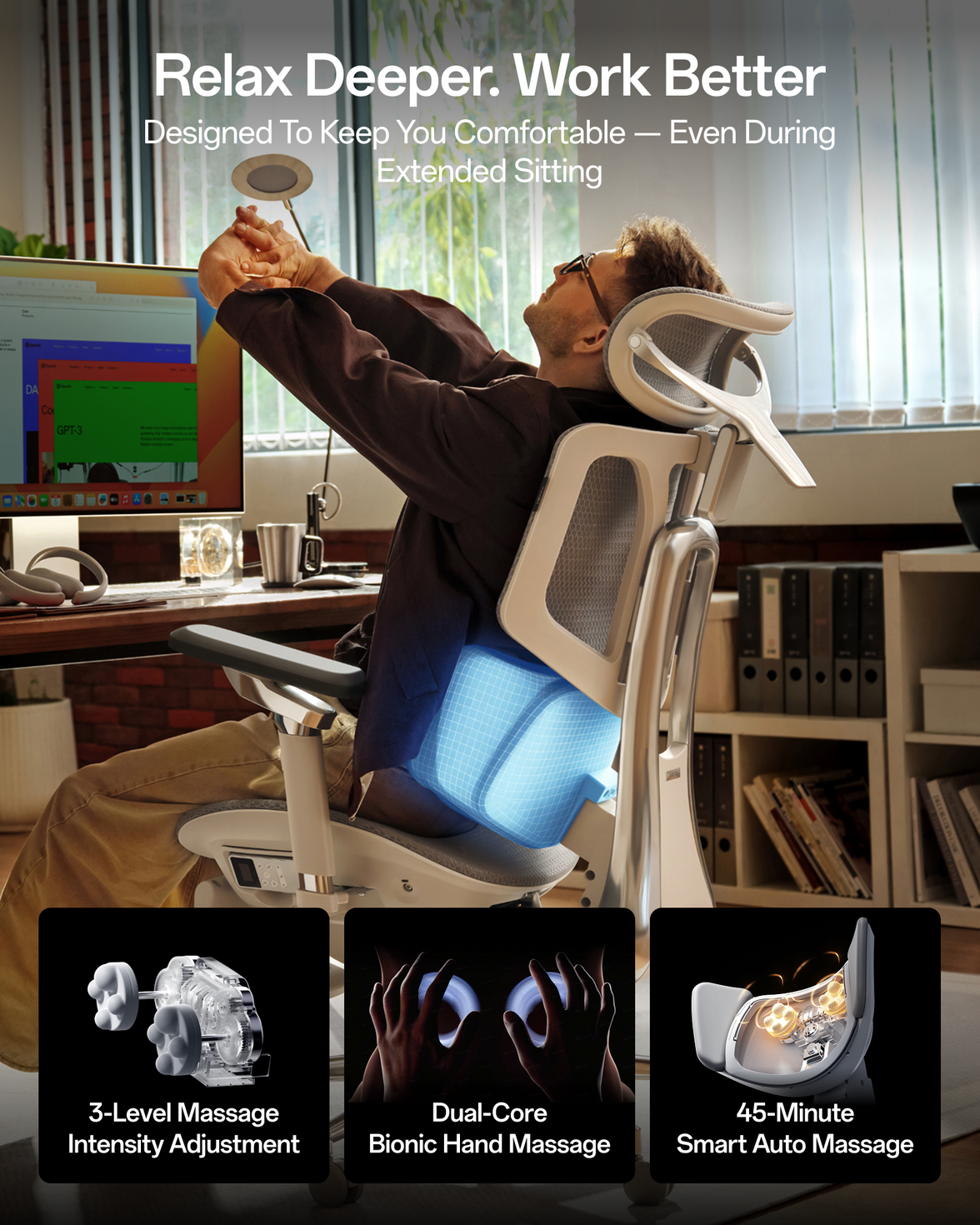
Massage
Movement for a different support feel
Built-in massage may offer selectable patterns or intensity settings. A massage function does not automatically mean the chair detects fatigue.
Ventilation
Powered airflow
Fans can move air through or around the seat. This is different from passive mesh ventilation and should not be confused with refrigerated cooling.
Heating
Optional warmth
Heating adds warmth in a specified area. Review the controls and instructions; it is a comfort feature, not a promise to treat a medical condition.
Saved settings
Preferences, where supported
Some systems may retain selected settings. Saving a preference is different from learning your posture, and memory functions should be checked model by model.
Ask which functions you would actually use. A clear set of useful controls is more valuable than a long list of features you rarely turn on.
07 / THE VALUE QUESTION
Is an AI Office Chair Actually Worth the Price?
That depends on how you work and how the chair feels to you. If your day includes focused typing, calls, and reclined breaks, automatic lumbar adjustment may offer a useful convenience as you change position.
If you prefer a simpler setup, a well-fitting mechanical ergonomic chair can still provide responsive support without batteries or powered controls.
Look beyond the feature list
Fit: Check seat height, depth, and width in centimetres, and whether the lumbar support reaches a comfortable position.
Control: Understand which settings you can change and how to select or disable powered functions.
Space: Check the chair's footprint and the clearance required for reclining.
Upkeep: Review charging instructions, electronic component coverage, and service options.
Everyday use: Consider whether the powered functions improve your routine enough to justify the difference in price.
Battery life depends on the model, settings, and functions you use. Avoid assuming a fixed charging schedule without checking the relevant specifications and usage conditions.
Buy for fit first, automation second. Smart functions can add convenience, but they cannot compensate for unsuitable seat dimensions or a poorly arranged desk.
08 / TECHNOLOGY IN PRACTICE
HBADA X7: A Real-World Example
The HBADA X7 smart ergonomic office chair illustrates this approach with AI lumbar tracking alongside massage, heating, and seat ventilation.
These functions complement the chair's adjustable components. Powered lumbar tracking and manual setup serve different purposes: one responds during use, while the other helps you fit the chair to your body and desk.
Meet the HBADA X7
Automatic support. A setup that is still yours.
Explore how the X7 combines lumbar tracking with adjustable seating and powered comfort functions. Review the current European product details and selected configuration before ordering.
Explore HBADA X7 →
When comparing options across HBADA's office chair range, begin with the adjustments you need every day, then decide which electronic functions would make a meaningful difference.
09 / SETTING EXPECTATIONS
Being Honest About What “AI” Means Here
It is worth pausing on the term itself. A chair marketed as AI-powered is not necessarily using the same kind of technology as a conversational AI assistant.
Automatic support can be produced by a sensor-driven control system. Whether a particular chair also uses machine learning, personalised prediction, or other techniques depends on its documented implementation.
Without that documentation, neither “it learns your body” nor “it is only pre-programmed” should be treated as an established fact.
Focus on the function you can evaluate: What adjusts? How does it feel? Can you control it? Does the chair fit? These questions are more useful than the label alone.
Similarly, words such as “smart”, “adaptive”, and “bionic” do not establish a medical benefit. Evaluate support and comfort separately from any claim about treating pain or correcting a health condition.
10 / QUICK CLARIFICATIONS
Frequently Asked Questions
What is an AI ergonomic chair, in simple terms?
It is a chair that uses electronic sensing and control to automate certain functions, such as adjusting lumbar support. The specific capabilities vary by model, and other chair adjustments may still be manual.
How does an office chair posture sensor actually work?
Sensors detect physical inputs such as pressure or component position. A controller can use those inputs to guide support adjustments. The sensor combination and response depend on the chair's design.
Is intelligent lumbar support better than a manual lumbar pad?
It may be more convenient if you value automatic adjustment as you move. It is not universally better: support position, pressure, adjustment range, and personal fit still determine whether it feels right. Mechanical adaptive support can also respond to movement.
Does “AI” in a smart ergonomic chair mean it uses machine learning?
Not necessarily. Automated sensor response alone does not prove that machine learning is involved. Check the manufacturer's technical explanation rather than inferring the software from the product label.
Are AI office chairs worth the higher price?
They can be worthwhile when automatic support and powered comfort functions are features you will use. Compare fit, controls, maintenance, and actual model prices. A well-adjusted mechanical chair may be a better match if you prefer simplicity.
Which HBADA chair is considered an AI ergonomic chair?
The HBADA X7 is one example, with AI lumbar tracking and additional powered comfort functions. Check the current European product page for the selected model's specifications.
Do I still need to adjust an AI ergonomic chair?
Yes. Automatic lumbar tracking does not mean every component adjusts itself. Set up the seat, armrests, and other controls according to the chair's instructions and your desk arrangement.
11 / THE TAKEAWAY
Comfort That Moves With You, Not the Other Way Around
The real appeal of an AI ergonomic chair is not the label itself. It is the convenience of having selected support functions respond automatically as your position changes.
That adds another option alongside manual adjustments and mechanically adaptive designs. Which approach works best depends on your body, workspace, preferences, and how much you value powered features.
Start with fit. Understand the controls. Then judge whether the smart features make your daily routine more comfortable and easier to manage.
A smarter chair is still one part of the setup. Give the same attention to your desk, screen, and working habits—and make room for regular changes of position and movement breaks.
Enjoyed this guide? Stay connected with HBADA.
Make HBADA one of your preferred sources on Google for more ergonomic chair guides, workspace tips, and practical advice.
Add HBADA as a preferred source on Google ↗
Opens Google in a new tab. Confirm your selection there if HBADA is available.
Back to top ↑
Oct 14, 2026
What Is an AI Ergonomic Chair? Smart Features Explained
Smart seating, explained simply
What makes a chair smart?Start with how it responds.
Sensors, automatic lumbar support, and built-in comfort features: here is what the technology does—and what still depends on you.
Quick answer
An AI ergonomic chair typically uses sensors and electronic controls to automate selected adjustments, such as lumbar support. In a motorised tracking system, sensor inputs help the chair respond to changes in position. The exact functions vary by model, and the “AI” label alone does not tell you whether a chair uses machine learning.
In this guide
Beyond manual adjustment
What makes a chair “AI”?
How posture sensors work
Intelligent lumbar support
Smart vs. traditional chairs
Other smart features
Is it worth the price?
The HBADA X7 example
What “AI” really means
Frequently asked questions
Final thoughts
01 / A DIFFERENT KIND OF ADJUSTMENT
Not Just Another Chair With More Knobs
“AI chair” gets thrown around a lot these days, and it is fair to wonder what sits behind the label. The useful question is not simply whether a chair is called smart. It is which adjustments the chair makes for you.
A traditional ergonomic chair relies on you to set features such as seat height, armrest position, and lumbar support. Some also use flexible backrests or mechanical systems that respond as you move, so traditional does not necessarily mean static.
A chair with electronically controlled lumbar tracking adds another approach: it uses sensor feedback to adjust selected support features while the system is active.
The practical difference is automation. Instead of manually changing every support setting, you let the chair handle a specific adjustment within its operating range. You still need to set up the rest of your workstation.
02 / THE CORE TECHNOLOGY
What Actually Makes a Chair “AI”?
For a motorised lumbar-tracking chair, the basic idea is a feedback loop: sensors detect a physical change, a controller interprets the input, and a mechanism adjusts the support.
01. SenseDetect changes in pressure, contact, or component position.
02. ProcessUse the readings and selected settings to determine a response.
03. AdjustMove the support within the mechanism's available range.
This is different from simply adding more manual adjustment points. But sensors and motors alone do not establish how sophisticated the software is, whether it learns from use, or how well the chair will fit a particular person.
When comparing smart chairs, look for a clear explanation of the feature: what it senses, what it changes, and which settings you control.
03 / READING MOVEMENT
The Office Chair Posture Sensor Behind the Curtain
A posture-sensing system uses physical measurements rather than an understanding of your body in the human sense. Different designs may use pressure sensors, position sensors, or a combination of inputs.
Contact and load
Pressure sensors
Pressure readings can indicate changes in the force applied to a sensing area. The controller can use that information as one input when adjusting support.
Component position
Magnetic position sensors
Hall-effect sensors detect magnetic-field changes. Depending on the design, those changes can help track a mechanism's position rather than directly measure the shape of your spine.
The controller then uses the available information to guide a response. Exact sensor types, sampling rates, and movement speeds are model-specific specifications—not features to assume from the words “AI chair.”
A useful distinction: Sensor sampling frequency is not the same as the time needed for a motor to complete an adjustment. A fast reading does not, by itself, tell you how the movement will feel.
04 / FROM INPUT TO SUPPORT
Intelligent Lumbar Support, Explained Step by Step
In a sensor-driven, motorised lumbar system, the sequence can be understood in five steps:
You change position. Leaning or shifting changes your contact with the chair.
The system detects a change. Its sensors register the relevant pressure or position inputs.
The controller determines a response. The response depends on the system's programming, selected mode, and available settings.
The mechanism adjusts the lumbar support. Movement remains within the chair's designed travel range and operating limits.
The system continues monitoring. Further input can prompt another adjustment while the tracking function is active.
The goal is to reduce the need for repeated manual lumbar adjustments as your position changes. It does not mean the chair can maintain identical contact through every movement, correct every sitting position, or adjust every part of the chair automatically.
05 / SIDE BY SIDE
Smart Office Chair vs. Traditional Adjustable Chair
The distinction is best understood by comparing how the support works—not by assuming one category is always comfortable and the other is not.
Factor
Traditional adjustable chair
Smart chair with motorised lumbar tracking
Initial setup
You adjust the chair to fit your body and desk.
You still set up the chair, then select available electronic modes.
Lumbar adjustment
May be manual, flexible, or mechanically adaptive.
Uses electronic feedback to adjust selected lumbar functions.
Response to movement
Depends on the backrest, recline, and support mechanism.
Combines the chair's mechanical design with powered tracking.
User input
Manual controls and mechanical settings.
Manual setup plus powered controls or support preferences.
Power needs
A purely mechanical chair needs no charging.
Electronic functions need a suitable power source.
Cost
Varies widely by construction and adjustment features.
Added electronics may increase cost; compare actual models.
What to prioritise
Fit, adjustment range, support feel, and build quality.
The same fundamentals, plus tracking behaviour and electronic support.
06 / BEYOND TRACKING
Beyond the Lumbar: Other Smart Features to Know
Lumbar tracking tends to be the headline feature, but smart chairs may also include powered comfort functions. These should be assessed individually rather than treated as proof that the chair learns or understands your needs.
Massage
Movement for a different support feel
Built-in massage may offer selectable patterns or intensity settings. A massage function does not automatically mean the chair detects fatigue.
Ventilation
Powered airflow
Fans can move air through or around the seat. This is different from passive mesh ventilation and should not be confused with refrigerated cooling.
Heating
Optional warmth
Heating adds warmth in a specified area. Review the controls and instructions; it is a comfort feature, not a promise to treat a medical condition.
Saved settings
Preferences, where supported
Some systems may retain selected settings. Saving a preference is different from learning your posture, and memory functions should be checked model by model.
Ask which functions you would actually use. A clear set of useful controls is more valuable than a long list of features you rarely turn on.
07 / THE VALUE QUESTION
Is an AI Office Chair Actually Worth the Price?
That depends on how you work and how the chair feels to you. If your day includes focused typing, calls, and reclined breaks, automatic lumbar adjustment may offer a useful convenience as you change position.
If you prefer a simpler setup, a well-fitting mechanical ergonomic chair can still provide responsive support without batteries or powered controls.
Look beyond the feature list
Fit: Check seat height, depth, and width in centimetres, and whether the lumbar support reaches a comfortable position.
Control: Understand which settings you can change and how to select or disable powered functions.
Space: Check the chair's footprint and the clearance required for reclining.
Upkeep: Review charging instructions, electronic component coverage, and service options.
Everyday use: Consider whether the powered functions improve your routine enough to justify the difference in price.
Battery life depends on the model, settings, and functions you use. Avoid assuming a fixed charging schedule without checking the relevant specifications and usage conditions.
Buy for fit first, automation second. Smart functions can add convenience, but they cannot compensate for unsuitable seat dimensions or a poorly arranged desk.
08 / TECHNOLOGY IN PRACTICE
HBADA X7: A Real-World Example
The HBADA X7 smart ergonomic office chair illustrates this approach with AI lumbar tracking alongside massage, heating, and seat ventilation.
These functions complement the chair's adjustable components. Powered lumbar tracking and manual setup serve different purposes: one responds during use, while the other helps you fit the chair to your body and desk.
Meet the HBADA X7
Automatic support. A setup that is still yours.
Explore how the X7 combines lumbar tracking with adjustable seating and powered comfort functions. Review the current European product details and selected configuration before ordering.
Explore HBADA X7 →
When comparing options across HBADA's office chair range, begin with the adjustments you need every day, then decide which electronic functions would make a meaningful difference.
09 / SETTING EXPECTATIONS
Being Honest About What “AI” Means Here
It is worth pausing on the term itself. A chair marketed as AI-powered is not necessarily using the same kind of technology as a conversational AI assistant.
Automatic support can be produced by a sensor-driven control system. Whether a particular chair also uses machine learning, personalised prediction, or other techniques depends on its documented implementation.
Without that documentation, neither “it learns your body” nor “it is only pre-programmed” should be treated as an established fact.
Focus on the function you can evaluate: What adjusts? How does it feel? Can you control it? Does the chair fit? These questions are more useful than the label alone.
Similarly, words such as “smart”, “adaptive”, and “bionic” do not establish a medical benefit. Evaluate support and comfort separately from any claim about treating pain or correcting a health condition.
10 / QUICK CLARIFICATIONS
Frequently Asked Questions
What is an AI ergonomic chair, in simple terms?
It is a chair that uses electronic sensing and control to automate certain functions, such as adjusting lumbar support. The specific capabilities vary by model, and other chair adjustments may still be manual.
How does an office chair posture sensor actually work?
Sensors detect physical inputs such as pressure or component position. A controller can use those inputs to guide support adjustments. The sensor combination and response depend on the chair's design.
Is intelligent lumbar support better than a manual lumbar pad?
It may be more convenient if you value automatic adjustment as you move. It is not universally better: support position, pressure, adjustment range, and personal fit still determine whether it feels right. Mechanical adaptive support can also respond to movement.
Does “AI” in a smart ergonomic chair mean it uses machine learning?
Not necessarily. Automated sensor response alone does not prove that machine learning is involved. Check the manufacturer's technical explanation rather than inferring the software from the product label.
Are AI office chairs worth the higher price?
They can be worthwhile when automatic support and powered comfort functions are features you will use. Compare fit, controls, maintenance, and actual model prices. A well-adjusted mechanical chair may be a better match if you prefer simplicity.
Which HBADA chair is considered an AI ergonomic chair?
The HBADA X7 is one example, with AI lumbar tracking and additional powered comfort functions. Check the current European product page for the selected model's specifications.
Do I still need to adjust an AI ergonomic chair?
Yes. Automatic lumbar tracking does not mean every component adjusts itself. Set up the seat, armrests, and other controls according to the chair's instructions and your desk arrangement.
11 / THE TAKEAWAY
Comfort That Moves With You, Not the Other Way Around
The real appeal of an AI ergonomic chair is not the label itself. It is the convenience of having selected support functions respond automatically as your position changes.
That adds another option alongside manual adjustments and mechanically adaptive designs. Which approach works best depends on your body, workspace, preferences, and how much you value powered features.
Start with fit. Understand the controls. Then judge whether the smart features make your daily routine more comfortable and easier to manage.
A smarter chair is still one part of the setup. Give the same attention to your desk, screen, and working habits—and make room for regular changes of position and movement breaks.
Enjoyed this guide? Stay connected with HBADA.
Make HBADA one of your preferred sources on Google for more ergonomic chair guides, workspace tips, and practical advice.
Add HBADA as a preferred source on Google ↗
Opens Google in a new tab. Confirm your selection there if HBADA is available.
Back to top ↑
Oct 14, 2026
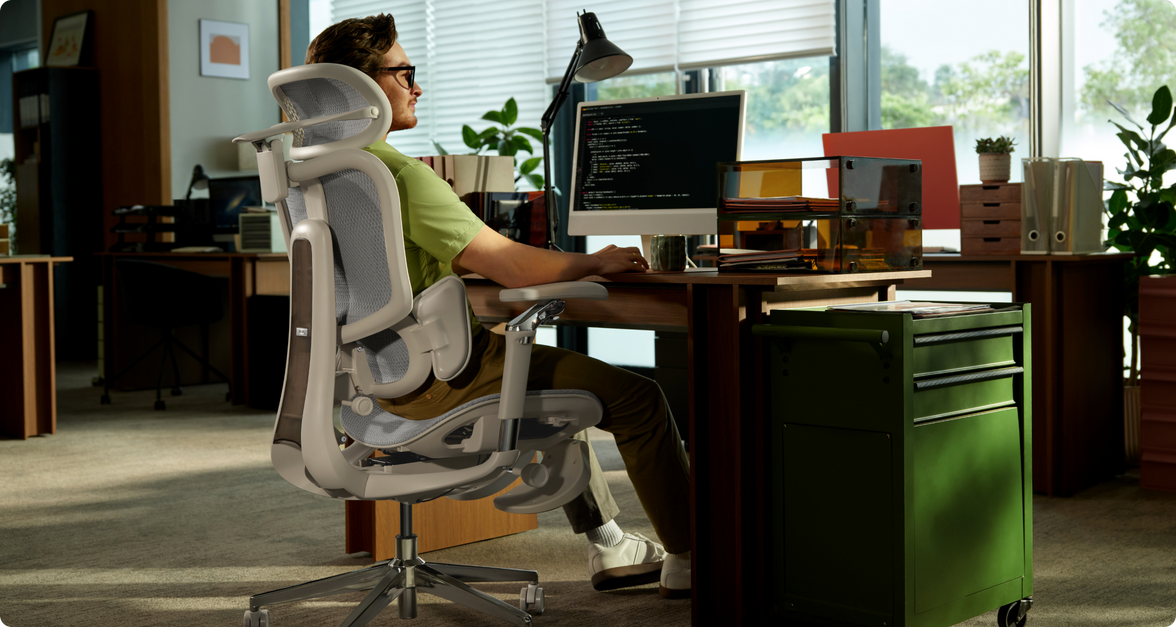 Office Chair With Footrest vs Separate Footrest: Which Is Better?
Chair buying guide · Support that suits your day
One supports your break. The other supports your desk setup.
Quick answer: A built-in retractable chair footrest is usually intended to support your legs during reclined breaks. A separate under-desk footrest provides a platform for your feet while you sit upright, particularly when they cannot comfortably reach the floor at your working seat height.
Neither is automatically better. Choose according to the support you need, the chair you already own, and the space available. Some workspaces can benefit from both, used at different times.
Resting your feet during a break sounds simple—until you start comparing chair features and desk accessories. Both may be called a “footrest”, but an attached leg rest and an under-desk platform often solve different problems. Understanding that distinction makes the choice much easier.
In this guide
Why this comparison matters
What a built-in footrest offers
What a separate footrest offers
Benefits and limitations
Quick comparison table
When built-in makes sense
When separate makes sense
HBADA footrest options
How to decide
Frequently asked questions
Final thoughts
01 / START WITH THE PURPOSE
Why This Comparison Matters
Foot and leg support is not just about putting your feet up. During upright desk work, you may need a stable surface beneath your feet. During a reclined break, you may want support further forward beneath your lower legs.
Those are different positions with different requirements. Choosing by the word “footrest” alone can leave you with a useful feature that does not solve your original problem.
For reclined breaks
Built-in leg support
An attached support that extends from the chair and retracts when it is not needed.
For upright desk work
Under-desk foot support
A separate platform that helps support your feet at your working seat height.
This guide uses “separate footrest” to mean an under-desk foot platform. A separate ottoman or reclining leg rest is another category and should be assessed differently.
02 / THE INTEGRATED OPTION
What a Built-In Footrest Actually Offers
A built-in chair footrest is an attached support that usually extends from beneath the seat. Depending on the design, it supports the lower legs or feet while you lean back. When retracted, it stays with the chair rather than remaining as a separate object under the desk.
The main appeal is integration. If you take seated reading or resting breaks, the support is already part of the chair. You do not need to find somewhere to store a separate leg rest.
However, operation varies. Some supports pull out manually; others use different controls. Being built into the chair does not mean that the footrest automatically extends, changes angle, or synchronises with the backrest.
Check the actual mechanism. Look at the instructions or demonstration for the exact model. Confirm how it extends, where it supports your legs, and how much clear space it needs.
03 / THE INDEPENDENT OPTION
What a Separate Footrest Offers
A separate under-desk footrest is a platform placed on the floor in front of your chair. Depending on the product, it may offer a fixed surface, adjustable height, an adjustable angle, or a rocking movement.
Its main advantage is independent positioning. You can place it where your feet naturally rest while keeping the chair at a suitable height for the desk.
This can be useful when lowering the seat enough to reach the floor would leave you too low relative to the keyboard. It can also be a straightforward addition to a chair that already fits you well.
Separate footrests work with many chair setups, but not automatically with every one. Check platform height, stability, surface grip, legroom, and whether the chair base leaves enough space.
04 / COMFORT WITHOUT OVERPROMISING
Office Chair Footrest Benefits, Either Way
Both options can make a suitable sitting position more comfortable, but their benefits are not interchangeable. The result depends on the design and how you use it.
For upright work: a correctly positioned under-desk platform can provide a stable place for your feet when the floor is out of reach.
For reclined breaks: an attached leg rest can provide a place to support your lower legs rather than leaving them unsupported.
For everyday convenience: a retractable support stays with the chair, while a separate platform can be repositioned independently.
For fit: either option should feel comfortable without forcing your legs into an awkward position or creating a concentrated pressure point.
Support is not a treatment. Neither type should be presented as a guaranteed way to reduce swelling, improve circulation, or treat back pain. A comfortable seated break also does not replace standing up and moving.
05 / AT A GLANCE
Quick Comparison Table
Compare the intended use—not just the name
Factor
Built-in chair footrest
Separate under-desk footrest
Main purpose
Usually intended for leg support during reclined breaks.
Usually intended for foot support during upright desk work.
Operation
Extends from the chair; controls and adjustment vary.
Positioned independently; height and angle depend on the model.
Recline linkage
Not necessarily synchronised with the backrest.
Not mechanically linked to the chair.
Cost
May be included or offered as a paid configuration.
Often costs less than replacing an otherwise suitable chair.
Compatibility
Designed for a particular chair or configuration.
Works with many setups if height and clearance are suitable.
Space
Stores with the chair but needs space when extended.
Occupies floor space beneath the desk.
Best starting point
You want integrated support for seated recline breaks.
Your feet need support at your normal working seat height.
06 / WHEN YOU LEAN BACK
When a Reclining Office Chair With Footrest Makes Sense
If your day includes seated reading breaks or moments when you lean back to rest, a built-in footrest can be a convenient option—particularly if you are already choosing a new chair.
It may also suit a workspace where you prefer an integrated design instead of a separate leg rest that needs its own storage space.
Before deciding, check where the support meets your legs. Its length, shape, and position should suit your body. Also allow room in front for extension and behind for the backrest to recline.
Follow the model’s instructions and load limits. Do not assume that the footrest can be stood on or used as an extra seat.
07 / WHEN YOU ARE WORKING
When a Separate Footrest Makes More Sense
If your current chair fits well but your feet do not reach the floor at a suitable desk-working height, a separate under-desk footrest may be the more relevant option.
It lets you support your feet without buying a different chair purely to add that function. Look for a stable platform with enough usable area for both feet and a height or angle that suits your position.
Check that it does not push your knees too high, crowd the desk opening, or force your chair further away from the keyboard. A platform that slides around on the floor may also be difficult to use comfortably.
For a full setup check, see the HBADA ergonomic adjustment and setup FAQ . Seat height, seat depth, desk height, and foot support should be considered together.
08 / CHOOSING YOUR HBADA CONFIGURATION
How HBADA Handles Built-In Footrests
Footrest availability depends on the model, market, and configuration. Check the selected option rather than assuming that every chair in a series includes the same features.
The HBADA E3 Pro EU product page lists “With Footrest” and “Without Footrest” options. Confirm your chosen variant and its availability before checkout.
What to check before ordering
Option
What to consider
E3 Pro with footrest
Consider it if you want attached leg support for reclined breaks. Check extension space and the operating instructions.
E3 Pro without footrest
Consider it if you do not need attached leg support. You can separately assess whether your feet need an under-desk platform while working.
Other HBADA models
Verify the exact product listing and selected variant. Do not carry specifications over from another model, market, or version.
Choose the chair first. Choose the footrest for your routine.
Seat fit, lumbar support, and armrest positioning remain important whether or not you choose a built-in footrest. Start with a chair that suits your desk work, then decide whether attached leg support adds value to your breaks.
Explore HBADA E3 Pro options →
09 / MAKE THE CHOICE PRACTICAL
How to Decide
Ask what you want the support to do before comparing accessories or chair upgrades.
Do your feet need support while typing? Check your seat and desk setup first. If your feet cannot reach the floor at a suitable working height, consider an appropriately sized under-desk footrest.
Do you want leg support when reclining? A chair with a built-in footrest may suit that use. Check the extension mechanism, fit, and available space.
Are you keeping your current chair? If it already suits you, a separate platform may solve an upright foot-support problem without replacing it.
Are you buying a new chair anyway? Compare the price and features of the exact variants. Do not assume that an included footrest adds little or no cost.
Do you have room for the support? Measure the under-desk space for a platform and the extended footprint for a built-in leg rest.
It does not always have to be either/or. You might use an under-desk platform for upright work and a retractable leg rest during breaks. Check that the two do not obstruct each other, and move the separate platform when necessary.
10 / YOUR QUESTIONS
Frequently Asked Questions
Is an office chair with a footrest better than a separate footrest?
Not universally. An attached retractable footrest usually suits reclined breaks. A separate under-desk footrest is often more relevant when you need support beneath your feet during upright work.
What comfort benefits can either option offer?
A suitable platform can support your feet at your working seat height, while a built-in leg rest can make a reclined position more comfortable. Neither provides a guaranteed treatment for pain, swelling, or circulation problems.
Is a built-in chair footrest worth paying extra for?
It can be if you expect to use it for seated recline breaks and the design fits your body and workspace. Compare the actual variant prices and operation rather than assuming it moves automatically with the backrest.
Can I add a separate footrest to any office chair?
It can work with many chairs, but check the complete setup. The platform should be stable, provide comfortable foot support, and fit beneath your desk without crowding your knees or chair base.
Can I choose a HBADA E3 Pro with a footrest?
The EU E3 Pro listing offers with-footrest and without-footrest options. Check the selected variant, current availability, and product details before ordering.
Does a retractable footrest work for short breaks?
Yes, when used as intended and adjusted appropriately. Return it to its storage position before getting up if the instructions require this, and keep standing and movement breaks in your routine.
11 / THE TAKEAWAY
Final Thoughts
There is no single winner in the built-in versus separate footrest comparison, because the two often serve different purposes.
Choose a built-in option when you want integrated leg support for reclined breaks. Consider a separate under-desk platform when your feet need support at your working seat height and you want to keep your existing chair.
Whichever option you choose, check the fit, available space, and intended use. A useful footrest should support the way you sit—not encourage you to stay in one position all day.
Enjoyed this guide? Stay connected with HBADA.
Make HBADA one of your preferred sources on Google for more ergonomic chair guides, workspace tips, and practical advice.
Add HBADA as a preferred source on Google ↗
Opens Google in a new tab. Confirm your selection there if HBADA is available.
Back to the top ↑
Oct 13, 2026
Office Chair With Footrest vs Separate Footrest: Which Is Better?
Chair buying guide · Support that suits your day
One supports your break. The other supports your desk setup.
Quick answer: A built-in retractable chair footrest is usually intended to support your legs during reclined breaks. A separate under-desk footrest provides a platform for your feet while you sit upright, particularly when they cannot comfortably reach the floor at your working seat height.
Neither is automatically better. Choose according to the support you need, the chair you already own, and the space available. Some workspaces can benefit from both, used at different times.
Resting your feet during a break sounds simple—until you start comparing chair features and desk accessories. Both may be called a “footrest”, but an attached leg rest and an under-desk platform often solve different problems. Understanding that distinction makes the choice much easier.
In this guide
Why this comparison matters
What a built-in footrest offers
What a separate footrest offers
Benefits and limitations
Quick comparison table
When built-in makes sense
When separate makes sense
HBADA footrest options
How to decide
Frequently asked questions
Final thoughts
01 / START WITH THE PURPOSE
Why This Comparison Matters
Foot and leg support is not just about putting your feet up. During upright desk work, you may need a stable surface beneath your feet. During a reclined break, you may want support further forward beneath your lower legs.
Those are different positions with different requirements. Choosing by the word “footrest” alone can leave you with a useful feature that does not solve your original problem.
For reclined breaks
Built-in leg support
An attached support that extends from the chair and retracts when it is not needed.
For upright desk work
Under-desk foot support
A separate platform that helps support your feet at your working seat height.
This guide uses “separate footrest” to mean an under-desk foot platform. A separate ottoman or reclining leg rest is another category and should be assessed differently.
02 / THE INTEGRATED OPTION
What a Built-In Footrest Actually Offers
A built-in chair footrest is an attached support that usually extends from beneath the seat. Depending on the design, it supports the lower legs or feet while you lean back. When retracted, it stays with the chair rather than remaining as a separate object under the desk.
The main appeal is integration. If you take seated reading or resting breaks, the support is already part of the chair. You do not need to find somewhere to store a separate leg rest.
However, operation varies. Some supports pull out manually; others use different controls. Being built into the chair does not mean that the footrest automatically extends, changes angle, or synchronises with the backrest.
Check the actual mechanism. Look at the instructions or demonstration for the exact model. Confirm how it extends, where it supports your legs, and how much clear space it needs.
03 / THE INDEPENDENT OPTION
What a Separate Footrest Offers
A separate under-desk footrest is a platform placed on the floor in front of your chair. Depending on the product, it may offer a fixed surface, adjustable height, an adjustable angle, or a rocking movement.
Its main advantage is independent positioning. You can place it where your feet naturally rest while keeping the chair at a suitable height for the desk.
This can be useful when lowering the seat enough to reach the floor would leave you too low relative to the keyboard. It can also be a straightforward addition to a chair that already fits you well.
Separate footrests work with many chair setups, but not automatically with every one. Check platform height, stability, surface grip, legroom, and whether the chair base leaves enough space.
04 / COMFORT WITHOUT OVERPROMISING
Office Chair Footrest Benefits, Either Way
Both options can make a suitable sitting position more comfortable, but their benefits are not interchangeable. The result depends on the design and how you use it.
For upright work: a correctly positioned under-desk platform can provide a stable place for your feet when the floor is out of reach.
For reclined breaks: an attached leg rest can provide a place to support your lower legs rather than leaving them unsupported.
For everyday convenience: a retractable support stays with the chair, while a separate platform can be repositioned independently.
For fit: either option should feel comfortable without forcing your legs into an awkward position or creating a concentrated pressure point.
Support is not a treatment. Neither type should be presented as a guaranteed way to reduce swelling, improve circulation, or treat back pain. A comfortable seated break also does not replace standing up and moving.
05 / AT A GLANCE
Quick Comparison Table
Compare the intended use—not just the name
Factor
Built-in chair footrest
Separate under-desk footrest
Main purpose
Usually intended for leg support during reclined breaks.
Usually intended for foot support during upright desk work.
Operation
Extends from the chair; controls and adjustment vary.
Positioned independently; height and angle depend on the model.
Recline linkage
Not necessarily synchronised with the backrest.
Not mechanically linked to the chair.
Cost
May be included or offered as a paid configuration.
Often costs less than replacing an otherwise suitable chair.
Compatibility
Designed for a particular chair or configuration.
Works with many setups if height and clearance are suitable.
Space
Stores with the chair but needs space when extended.
Occupies floor space beneath the desk.
Best starting point
You want integrated support for seated recline breaks.
Your feet need support at your normal working seat height.
06 / WHEN YOU LEAN BACK
When a Reclining Office Chair With Footrest Makes Sense
If your day includes seated reading breaks or moments when you lean back to rest, a built-in footrest can be a convenient option—particularly if you are already choosing a new chair.
It may also suit a workspace where you prefer an integrated design instead of a separate leg rest that needs its own storage space.
Before deciding, check where the support meets your legs. Its length, shape, and position should suit your body. Also allow room in front for extension and behind for the backrest to recline.
Follow the model’s instructions and load limits. Do not assume that the footrest can be stood on or used as an extra seat.
07 / WHEN YOU ARE WORKING
When a Separate Footrest Makes More Sense
If your current chair fits well but your feet do not reach the floor at a suitable desk-working height, a separate under-desk footrest may be the more relevant option.
It lets you support your feet without buying a different chair purely to add that function. Look for a stable platform with enough usable area for both feet and a height or angle that suits your position.
Check that it does not push your knees too high, crowd the desk opening, or force your chair further away from the keyboard. A platform that slides around on the floor may also be difficult to use comfortably.
For a full setup check, see the HBADA ergonomic adjustment and setup FAQ . Seat height, seat depth, desk height, and foot support should be considered together.
08 / CHOOSING YOUR HBADA CONFIGURATION
How HBADA Handles Built-In Footrests
Footrest availability depends on the model, market, and configuration. Check the selected option rather than assuming that every chair in a series includes the same features.
The HBADA E3 Pro EU product page lists “With Footrest” and “Without Footrest” options. Confirm your chosen variant and its availability before checkout.
What to check before ordering
Option
What to consider
E3 Pro with footrest
Consider it if you want attached leg support for reclined breaks. Check extension space and the operating instructions.
E3 Pro without footrest
Consider it if you do not need attached leg support. You can separately assess whether your feet need an under-desk platform while working.
Other HBADA models
Verify the exact product listing and selected variant. Do not carry specifications over from another model, market, or version.
Choose the chair first. Choose the footrest for your routine.
Seat fit, lumbar support, and armrest positioning remain important whether or not you choose a built-in footrest. Start with a chair that suits your desk work, then decide whether attached leg support adds value to your breaks.
Explore HBADA E3 Pro options →
09 / MAKE THE CHOICE PRACTICAL
How to Decide
Ask what you want the support to do before comparing accessories or chair upgrades.
Do your feet need support while typing? Check your seat and desk setup first. If your feet cannot reach the floor at a suitable working height, consider an appropriately sized under-desk footrest.
Do you want leg support when reclining? A chair with a built-in footrest may suit that use. Check the extension mechanism, fit, and available space.
Are you keeping your current chair? If it already suits you, a separate platform may solve an upright foot-support problem without replacing it.
Are you buying a new chair anyway? Compare the price and features of the exact variants. Do not assume that an included footrest adds little or no cost.
Do you have room for the support? Measure the under-desk space for a platform and the extended footprint for a built-in leg rest.
It does not always have to be either/or. You might use an under-desk platform for upright work and a retractable leg rest during breaks. Check that the two do not obstruct each other, and move the separate platform when necessary.
10 / YOUR QUESTIONS
Frequently Asked Questions
Is an office chair with a footrest better than a separate footrest?
Not universally. An attached retractable footrest usually suits reclined breaks. A separate under-desk footrest is often more relevant when you need support beneath your feet during upright work.
What comfort benefits can either option offer?
A suitable platform can support your feet at your working seat height, while a built-in leg rest can make a reclined position more comfortable. Neither provides a guaranteed treatment for pain, swelling, or circulation problems.
Is a built-in chair footrest worth paying extra for?
It can be if you expect to use it for seated recline breaks and the design fits your body and workspace. Compare the actual variant prices and operation rather than assuming it moves automatically with the backrest.
Can I add a separate footrest to any office chair?
It can work with many chairs, but check the complete setup. The platform should be stable, provide comfortable foot support, and fit beneath your desk without crowding your knees or chair base.
Can I choose a HBADA E3 Pro with a footrest?
The EU E3 Pro listing offers with-footrest and without-footrest options. Check the selected variant, current availability, and product details before ordering.
Does a retractable footrest work for short breaks?
Yes, when used as intended and adjusted appropriately. Return it to its storage position before getting up if the instructions require this, and keep standing and movement breaks in your routine.
11 / THE TAKEAWAY
Final Thoughts
There is no single winner in the built-in versus separate footrest comparison, because the two often serve different purposes.
Choose a built-in option when you want integrated leg support for reclined breaks. Consider a separate under-desk platform when your feet need support at your working seat height and you want to keep your existing chair.
Whichever option you choose, check the fit, available space, and intended use. A useful footrest should support the way you sit—not encourage you to stay in one position all day.
Enjoyed this guide? Stay connected with HBADA.
Make HBADA one of your preferred sources on Google for more ergonomic chair guides, workspace tips, and practical advice.
Add HBADA as a preferred source on Google ↗
Opens Google in a new tab. Confirm your selection there if HBADA is available.
Back to the top ↑
Oct 13, 2026
 Understanding Your Lower Back Muscles: What the Erector Spinae and Quadratus Lumborum Do
Lower back anatomy · Everyday sitting
Two muscle groups. A clearer picture of lumbar support.
Quick answer: Two important lower back muscles are the erector spinae and the quadratus lumborum. The erector spinae run in columns along both sides of your spine and help keep your trunk upright. The quadratus lumborum sits deeper and further out to each side, linking the pelvis, lumbar vertebrae, and lowest rib. It helps with side bending and trunk stability.
Knowing where they sit helps explain why office chair lumbar support should be judged by its placement, coverage, and fit—not by the idea that it can target a single muscle.
This article provides general education, not medical advice. An office chair is not a treatment for back pain.
Most people only think about their back when it hurts. A little anatomy changes how you think about sitting. Once you understand what the muscles do while you work, lumbar support placement and coverage start making practical sense.
In this guide
Why anatomy belongs in a chair conversation
Lower back anatomy at a glance
The erector spinae
The quadratus lumborum
How the muscles work together
What long sitting asks of your back
Placement, coverage, and fit
HBADA’s three-zone design
Frequently asked questions
What a chair can—and cannot—do
01 / THE CONTEXT
Why Anatomy Belongs in a Chair Conversation
Chair specs usually talk about adjustment ranges and materials, and office chair lumbar support is often reduced to a single adjustable pad. They rarely explain what is behind your back. But a lumbar pad sits against a real region of the body, with muscles on either side of the spine.
Understanding that region helps you judge whether a chair’s support is placed, shaped, and sized sensibly.
Think of this article as a map. It explains the terrain, then shows how chair design relates to it, without overpromising what any chair can do.
02 / THE BASICS
Lower Back Anatomy at a Glance
Your lumbar spine typically consists of five vertebrae, called L1 to L5, stacked between your rib cage and pelvis. This section normally curves inward, forming the small of your back. Muscles, ligaments, and connective tissue surround it.
Some muscles run in long bands beside the spine. Others sit deeper and wider, connecting the spine, ribs, and pelvis. This basic lower back anatomy is the setting for the two muscle groups below.
Along the spine
Erector spinae
Long muscle columns that contribute to upright posture, spinal extension, and control during forward bending.
Deeper and to the sides
Quadratus lumborum
A muscle on each side linking the pelvis, lower spine, and lowest rib, contributing to side bending and stability.
03 / ERECTOR SPINAE
The Erector Spinae: Location and Function
The erector spinae is not one muscle but a group of three columns: the iliocostalis, longissimus, and spinalis. Together, these columns extend along both sides of the spine, with different portions attaching to the pelvis, vertebrae, ribs, neck, and skull.
Their main roles include extending the spine and helping keep the trunk upright. Working on both sides together, they straighten the trunk. Working on one side, they contribute to sideways bending.
They also help control forward bending: rather than simply letting the trunk fall forwards, they can lengthen under load to help manage the movement.
That role matters at a desk. These muscles contribute to postural control, although how much they work depends on your position, backrest support, and the task you are doing.
04 / QUADRATUS LUMBORUM
The Quadratus Lumborum: Location and Function
Simplified anatomy illustration, not a diagnostic image.
The quadratus lumborum, often shortened to QL, is a roughly four-sided muscle in the deeper lower-back region. It connects the top of the pelvis—the iliac crest—with the twelfth rib and the transverse processes of the upper lumbar vertebrae.
When one side contracts, the QL helps bend the trunk sideways and can lift that side of the pelvis. It contributes to lumbar stability and can assist extension. It also helps hold the twelfth rib steady during breathing.
Support for a region is not direct contact with a muscle. The QL sits deep within the body. A chair contacts the surface of your back; it cannot directly touch or isolate the quadratus lumborum.
Erector spinae and quadratus lumborum at a glance
Muscle
Where it sits
Main roles
Erector spinae
Long muscle columns along both sides of the spine.
Extend the spine, contribute to upright posture, and control forward bending.
Quadratus lumborum
Deeper in the lower back, connecting the pelvis, twelfth rib, and upper lumbar vertebrae.
Assist side bending, stabilise the lower back, and steady the twelfth rib.
05 / SHARED WORK
How the Two Muscles Work Together
Neither muscle works alone. Along with deeper stabilisers and the abdominal muscles, they form part of a system that keeps the trunk stable while you move.
The erector spinae contribute to forward-and-back control. The QL contributes to side-to-side control and helps stabilise the relationship between the pelvis and ribs. Their roles overlap rather than fitting into separate, independent jobs.
Reaching for a mug, turning towards a second monitor, and leaning back during a call all change the demands on your trunk. This is why it is useful to assess chair support during normal movement, not just while sitting perfectly still.
06 / AT YOUR DESK
What Long Sitting Asks of Your Lower Back Muscles
Sitting does not automatically mean the muscles of your back are resting. Their activity changes with your posture and with how much support the chair provides.
In a slumped position, the lumbar curve generally becomes flatter, and the balance of load between muscles and passive tissues changes. Holding yourself rigidly upright can also become tiring. Neither position needs to be treated as something you must maintain for hours.
Lower back discomfort has many possible contributors. Sitting habits, physical activity, workload, and individual health all matter, so a chair is only one part of the picture.
The practical takeaway: choose a comfortable, supported position, then vary it. A well-adjusted backrest does not replace getting up and moving throughout the day.
07 / FROM ANATOMY TO SETUP
From Anatomy to Chair: Placement, Coverage, and Fit
This is where anatomy turns into practical advice. Three ideas matter most.
Placement
Support should meet the natural inward curve of your lower back. Your belt line can be a starting reference, but body proportions vary. Adjust the support until it feels comfortably placed rather than pressing too high or too low.
Use the HBADA ergonomic adjustment and setup FAQ for guidance on getting started.
Coverage
The lumbar region is not a single point. It includes the centre of the lower back and the areas on either side. A central section with side sections is one way to provide contact across this region.
Wider contact is not automatically better. Check whether the shape suits your body without creating concentrated pressure or pushing you away from the backrest.
Fit
Body size changes everything. Torso length, hip width, and seat depth affect whether support lands where you need it. A chair that does not fit may leave a gap behind your back or press unevenly.
Adjust seat height and depth alongside the backrest. Lumbar support should be assessed as part of the whole seating setup, not in isolation.
A practical lumbar support checklist
Consideration
What to check
Placement
The support meets your lower-back curve comfortably, rather than pressing into the wrong area.
Coverage
Contact feels comfortable across the supported region, without an isolated pressure point.
Fit
Seat depth and backrest position allow your back to reach the support while your feet remain supported.
Movement
Support feels comfortable as you shift or recline within the chair’s intended adjustment range.
Setup finishes the job. The HBADA Chair Owner’s Hub brings the wider seating setup into the conversation, including seat height, armrests, and backrest adjustments.
08 / THE HBADA APPROACH
How HBADA’s Three-Zone Design Approaches This
Shown: HBADA E3 Ultra. The description below discusses the E3 Pro; support shape and adjustment features vary by model.
HBADA’s three-zone lumbar design, found on the HBADA E3 Pro, is one approach to the coverage and movement questions above. It combines a central support section with two side wings.
The central section supports the middle of the lower-back region, while the side wings provide contact towards either side. The adjustable wings allow the support shape to be adapted rather than relying on one fixed central pad.
To be clear about what this does and does not claim: the design is intended to support the central and lateral lower-back areas. This is not evidence that a chair isolates or treats a particular muscle, and no backrest directly contacts deep structures such as the quadratus lumborum.
Explore the design, then check your fit
Review the E3 Pro’s lumbar adjustments and seat dimensions alongside your own body measurements. The useful question is whether the chair gives you comfortable contact—not whether a feature name matches a muscle name.
Explore HBADA E3 Pro →
09 / YOUR QUESTIONS
Frequently Asked Questions
What are the main lower back muscles?
Important muscles include the erector spinae, quadratus lumborum, and multifidus. They work with other trunk muscles, including the abdominal muscles, to support movement and stability.
Where is the erector spinae located?
The erector spinae forms three muscle columns along both sides of the spine. Different portions extend between the pelvis, vertebrae, ribs, neck, and skull.
What does the quadratus lumborum do?
The quadratus lumborum helps bend the trunk sideways, contributes to lumbar stability, and steadies the twelfth rib during breathing. It connects the pelvis, lowest rib, and upper lumbar vertebrae.
Can office chair lumbar support target a specific muscle?
A chair supports the surface of your back and may change how your body is supported. It cannot isolate or treat a single muscle, especially a deep muscle such as the quadratus lumborum.
Why does coverage matter for lumbar support?
The lower-back region includes the centre and both sides. Support shape and coverage influence where the backrest contacts your body. More coverage is not automatically better; the contact should suit your shape and feel comfortable as you move.
Should I see a professional about lower back pain?
Seek medical advice if pain is persistent, severe, worsening, or spreading. A chair can support sitting comfort, but it is not a substitute for assessment or treatment.
10 / THE TAKEAWAY
A Chair Can Support the Area, Not Do the Muscles’ Job
Your erector spinae and quadratus lumborum contribute to keeping your trunk upright and stable. A chair’s role is more modest: it can offer comfortable support at the right height, across a suitable area, in a size that fits you.
That is a worthwhile goal, and it is why placement, coverage, and fit deserve more attention than a long feature list. But a chair does not replace regular movement or activity appropriate to your needs.
Choose a chair with the anatomy in mind, set it up carefully, and change position throughout the day rather than asking your body to hold the same posture for hours.
Understand the region. Adjust the support. Keep movement part of your day.
Back to the top ↑
Oct 13, 2026
Understanding Your Lower Back Muscles: What the Erector Spinae and Quadratus Lumborum Do
Lower back anatomy · Everyday sitting
Two muscle groups. A clearer picture of lumbar support.
Quick answer: Two important lower back muscles are the erector spinae and the quadratus lumborum. The erector spinae run in columns along both sides of your spine and help keep your trunk upright. The quadratus lumborum sits deeper and further out to each side, linking the pelvis, lumbar vertebrae, and lowest rib. It helps with side bending and trunk stability.
Knowing where they sit helps explain why office chair lumbar support should be judged by its placement, coverage, and fit—not by the idea that it can target a single muscle.
This article provides general education, not medical advice. An office chair is not a treatment for back pain.
Most people only think about their back when it hurts. A little anatomy changes how you think about sitting. Once you understand what the muscles do while you work, lumbar support placement and coverage start making practical sense.
In this guide
Why anatomy belongs in a chair conversation
Lower back anatomy at a glance
The erector spinae
The quadratus lumborum
How the muscles work together
What long sitting asks of your back
Placement, coverage, and fit
HBADA’s three-zone design
Frequently asked questions
What a chair can—and cannot—do
01 / THE CONTEXT
Why Anatomy Belongs in a Chair Conversation
Chair specs usually talk about adjustment ranges and materials, and office chair lumbar support is often reduced to a single adjustable pad. They rarely explain what is behind your back. But a lumbar pad sits against a real region of the body, with muscles on either side of the spine.
Understanding that region helps you judge whether a chair’s support is placed, shaped, and sized sensibly.
Think of this article as a map. It explains the terrain, then shows how chair design relates to it, without overpromising what any chair can do.
02 / THE BASICS
Lower Back Anatomy at a Glance
Your lumbar spine typically consists of five vertebrae, called L1 to L5, stacked between your rib cage and pelvis. This section normally curves inward, forming the small of your back. Muscles, ligaments, and connective tissue surround it.
Some muscles run in long bands beside the spine. Others sit deeper and wider, connecting the spine, ribs, and pelvis. This basic lower back anatomy is the setting for the two muscle groups below.
Along the spine
Erector spinae
Long muscle columns that contribute to upright posture, spinal extension, and control during forward bending.
Deeper and to the sides
Quadratus lumborum
A muscle on each side linking the pelvis, lower spine, and lowest rib, contributing to side bending and stability.
03 / ERECTOR SPINAE
The Erector Spinae: Location and Function
The erector spinae is not one muscle but a group of three columns: the iliocostalis, longissimus, and spinalis. Together, these columns extend along both sides of the spine, with different portions attaching to the pelvis, vertebrae, ribs, neck, and skull.
Their main roles include extending the spine and helping keep the trunk upright. Working on both sides together, they straighten the trunk. Working on one side, they contribute to sideways bending.
They also help control forward bending: rather than simply letting the trunk fall forwards, they can lengthen under load to help manage the movement.
That role matters at a desk. These muscles contribute to postural control, although how much they work depends on your position, backrest support, and the task you are doing.
04 / QUADRATUS LUMBORUM
The Quadratus Lumborum: Location and Function
Simplified anatomy illustration, not a diagnostic image.
The quadratus lumborum, often shortened to QL, is a roughly four-sided muscle in the deeper lower-back region. It connects the top of the pelvis—the iliac crest—with the twelfth rib and the transverse processes of the upper lumbar vertebrae.
When one side contracts, the QL helps bend the trunk sideways and can lift that side of the pelvis. It contributes to lumbar stability and can assist extension. It also helps hold the twelfth rib steady during breathing.
Support for a region is not direct contact with a muscle. The QL sits deep within the body. A chair contacts the surface of your back; it cannot directly touch or isolate the quadratus lumborum.
Erector spinae and quadratus lumborum at a glance
Muscle
Where it sits
Main roles
Erector spinae
Long muscle columns along both sides of the spine.
Extend the spine, contribute to upright posture, and control forward bending.
Quadratus lumborum
Deeper in the lower back, connecting the pelvis, twelfth rib, and upper lumbar vertebrae.
Assist side bending, stabilise the lower back, and steady the twelfth rib.
05 / SHARED WORK
How the Two Muscles Work Together
Neither muscle works alone. Along with deeper stabilisers and the abdominal muscles, they form part of a system that keeps the trunk stable while you move.
The erector spinae contribute to forward-and-back control. The QL contributes to side-to-side control and helps stabilise the relationship between the pelvis and ribs. Their roles overlap rather than fitting into separate, independent jobs.
Reaching for a mug, turning towards a second monitor, and leaning back during a call all change the demands on your trunk. This is why it is useful to assess chair support during normal movement, not just while sitting perfectly still.
06 / AT YOUR DESK
What Long Sitting Asks of Your Lower Back Muscles
Sitting does not automatically mean the muscles of your back are resting. Their activity changes with your posture and with how much support the chair provides.
In a slumped position, the lumbar curve generally becomes flatter, and the balance of load between muscles and passive tissues changes. Holding yourself rigidly upright can also become tiring. Neither position needs to be treated as something you must maintain for hours.
Lower back discomfort has many possible contributors. Sitting habits, physical activity, workload, and individual health all matter, so a chair is only one part of the picture.
The practical takeaway: choose a comfortable, supported position, then vary it. A well-adjusted backrest does not replace getting up and moving throughout the day.
07 / FROM ANATOMY TO SETUP
From Anatomy to Chair: Placement, Coverage, and Fit
This is where anatomy turns into practical advice. Three ideas matter most.
Placement
Support should meet the natural inward curve of your lower back. Your belt line can be a starting reference, but body proportions vary. Adjust the support until it feels comfortably placed rather than pressing too high or too low.
Use the HBADA ergonomic adjustment and setup FAQ for guidance on getting started.
Coverage
The lumbar region is not a single point. It includes the centre of the lower back and the areas on either side. A central section with side sections is one way to provide contact across this region.
Wider contact is not automatically better. Check whether the shape suits your body without creating concentrated pressure or pushing you away from the backrest.
Fit
Body size changes everything. Torso length, hip width, and seat depth affect whether support lands where you need it. A chair that does not fit may leave a gap behind your back or press unevenly.
Adjust seat height and depth alongside the backrest. Lumbar support should be assessed as part of the whole seating setup, not in isolation.
A practical lumbar support checklist
Consideration
What to check
Placement
The support meets your lower-back curve comfortably, rather than pressing into the wrong area.
Coverage
Contact feels comfortable across the supported region, without an isolated pressure point.
Fit
Seat depth and backrest position allow your back to reach the support while your feet remain supported.
Movement
Support feels comfortable as you shift or recline within the chair’s intended adjustment range.
Setup finishes the job. The HBADA Chair Owner’s Hub brings the wider seating setup into the conversation, including seat height, armrests, and backrest adjustments.
08 / THE HBADA APPROACH
How HBADA’s Three-Zone Design Approaches This
Shown: HBADA E3 Ultra. The description below discusses the E3 Pro; support shape and adjustment features vary by model.
HBADA’s three-zone lumbar design, found on the HBADA E3 Pro, is one approach to the coverage and movement questions above. It combines a central support section with two side wings.
The central section supports the middle of the lower-back region, while the side wings provide contact towards either side. The adjustable wings allow the support shape to be adapted rather than relying on one fixed central pad.
To be clear about what this does and does not claim: the design is intended to support the central and lateral lower-back areas. This is not evidence that a chair isolates or treats a particular muscle, and no backrest directly contacts deep structures such as the quadratus lumborum.
Explore the design, then check your fit
Review the E3 Pro’s lumbar adjustments and seat dimensions alongside your own body measurements. The useful question is whether the chair gives you comfortable contact—not whether a feature name matches a muscle name.
Explore HBADA E3 Pro →
09 / YOUR QUESTIONS
Frequently Asked Questions
What are the main lower back muscles?
Important muscles include the erector spinae, quadratus lumborum, and multifidus. They work with other trunk muscles, including the abdominal muscles, to support movement and stability.
Where is the erector spinae located?
The erector spinae forms three muscle columns along both sides of the spine. Different portions extend between the pelvis, vertebrae, ribs, neck, and skull.
What does the quadratus lumborum do?
The quadratus lumborum helps bend the trunk sideways, contributes to lumbar stability, and steadies the twelfth rib during breathing. It connects the pelvis, lowest rib, and upper lumbar vertebrae.
Can office chair lumbar support target a specific muscle?
A chair supports the surface of your back and may change how your body is supported. It cannot isolate or treat a single muscle, especially a deep muscle such as the quadratus lumborum.
Why does coverage matter for lumbar support?
The lower-back region includes the centre and both sides. Support shape and coverage influence where the backrest contacts your body. More coverage is not automatically better; the contact should suit your shape and feel comfortable as you move.
Should I see a professional about lower back pain?
Seek medical advice if pain is persistent, severe, worsening, or spreading. A chair can support sitting comfort, but it is not a substitute for assessment or treatment.
10 / THE TAKEAWAY
A Chair Can Support the Area, Not Do the Muscles’ Job
Your erector spinae and quadratus lumborum contribute to keeping your trunk upright and stable. A chair’s role is more modest: it can offer comfortable support at the right height, across a suitable area, in a size that fits you.
That is a worthwhile goal, and it is why placement, coverage, and fit deserve more attention than a long feature list. But a chair does not replace regular movement or activity appropriate to your needs.
Choose a chair with the anatomy in mind, set it up carefully, and change position throughout the day rather than asking your body to hold the same posture for hours.
Understand the region. Adjust the support. Keep movement part of your day.
Back to the top ↑
Oct 13, 2026
 Will Your Office Chair Fit Under Your Desk? Measurement Guide
Quick answer
Measure the space.Then find your fit.
To check whether your office chair fits under your desk, compare the desk's lowest underside clearance with the height of the armrests from the floor. Measure the chair at the seat height you actually use, not only at its lowest setting. Then check the opening's width, legroom and any obstructions.
Desk clearance Floor to the lowest obstruction in the chair's path.
Armrest height Floor to the armrest top at your chosen seat height.
Room to move Check width, depth, legs, base and recline space.
In this guide
Why desk fit matters
The two key measurements
Checking armrest height
Desk and chair measurements
Clearance beyond armrests
How to measure your setup
Common fit problems
Comparing HBADA chairs
Frequently asked questions
Final thoughts
It's a surprisingly common problem. You unbox a new chair, roll it up to your desk, and the armrests hit the underside before you can get close enough to type. Suddenly, a comfortable chair feels awkward in your actual workspace.
This guide explains how to check desk and chair clearance before buying, or troubleshoot a setup you already own. A few measurements can help you choose a HBADA chair that works with your desk, rather than considering the two separately.
Why This Question Matters More Than People Expect
A chair that cannot move close enough to your desk can make everyday tasks less comfortable. If the armrests stop you too far from the keyboard, you may find yourself reaching forward instead of using the backrest.
That is why desk compatibility deserves attention alongside seat comfort and lumbar support. Even a highly adjustable chair needs enough physical room to work as intended.
Working fit and storage fit are different. Lowering the empty chair may help you tuck it away. For typing, check clearance again at your normal sitting height. You should not need an uncomfortable seat position simply to clear the desk.
The Two Measurements That Actually Decide Fit
Start with two measurements for vertical clearance. They tell you whether the armrests can pass beneath the desk, although width and depth still need checking.
The desk-clearance check
A A — Desk underside clearance
Measure from the floor to the lowest obstruction where the armrests will pass. Include drawers, support rails and keyboard trays.
B B — Floor-to-armrest height
Measure from the floor to the armrest top with the seat at your working height and the armrest in the position you want to use.
A − B = available vertical gap
Use centimetres for both measurements. A positive gap indicates vertical clearance at the measured point, not a guarantee that the whole chair fits. Check width, depth and the entire entry path too.
If the armrest top is equal to or higher than the lowest obstruction, it will not pass underneath in that position. If there is only a small gap, allow for floor unevenness and changes as the chair moves.
Office Chair Armrest Height: What to Check
An armrest height measurement can mean its height above the seat, its adjustment travel, or its total height from the floor. Only the last measurement can be compared directly with desk underside clearance.
Seat height also matters. Raising the seat generally raises the armrests with it, so a chair that clears the desk at its lowest setting may not clear it at your usual working height.
Check whether the dimension is measured from the floor or from the seat.
Confirm the seat-height setting used for that measurement.
Check armrest width and forward position as well as vertical adjustment.
Distinguish rotating arm pads from arms that fold completely out of the way.
When considering the HBADA E3 Pro , confirm the dimensions for the exact version you plan to buy. An adjustment range alone does not establish the minimum floor-to-armrest height.
Standard Desk and Chair Height: The Numbers That Matter
A desk's advertised height normally describes its top surface. The usable opening underneath is lower and depends on the desktop thickness, frame, drawers and accessories.
Instead of relying on a generic standard range, record the dimensions of your own setup. Two desks with the same overall height can provide very different chair clearance.
Your desk-and-chair measurement checklist
Measurement
How to measure it
Why it matters
Desktop height
Floor to the top of the work surface.
Describes working height, not the clearance underneath.
Underside clearance
Floor to the lowest obstruction along the chair's entry path.
Determines the available vertical space.
Floor-to-armrest height
Floor to the armrest top at your chosen seat height.
Compare directly with underside clearance.
Opening width
Narrowest clear space between legs, drawers or side panels.
Check against the chair parts that need to pass through.
Usable depth
Clear space from the desk edge to rear obstructions.
Determines how far the chair and your legs can move in.
Example only: a desk may be 74 cm tall but have just 69 cm of clearance beneath its frame. An armrest measuring 71 cm from the floor will hit the frame. An armrest at 66 cm leaves a 3 cm vertical gap, but width and depth still need checking. These are illustrative measurements, not HBADA specifications.
Desk Chair Clearance: More Than Just Armrests
Armrest height is only one part of the fit. Check the space around the chair as well as the opening beneath the desktop.
Width and base clearance
Desk legs and drawer units can block the armrests or chair base. Measure the narrowest opening and check the chair as it rolls and swivels, not only when it faces straight ahead.
Legroom and under-desk accessories
A keyboard tray, cable tray or rear support bar may reduce usable space. Confirm that your knees, thighs and feet have room in the position you actually use for work.
Recline and footrest space
Reclining needs room behind the chair, while an extended footrest needs space in front. A recline angle alone does not tell you the required floor space. Use the exact model's dimensions or measure its full movement rather than relying on one universal clearance figure.
How to Measure Your Own Setup
Use a tape measure and record these checks before comparing chairs or changing an existing setup.
Measure the desk's lowest obstruction. Check beneath the desktop and along the route the armrests will follow. Include the frame, drawers and trays rather than measuring only the front edge.
Set the chair for working, not storage. Use your normal seat height. Check the chair on the same floor or mat where it will be used.
Measure the armrest top from the floor. Record the height with the arms lowered, then check your preferred working position. Recheck during normal use if the seat compresses.
Compare the measurements and test gently. The armrests need to sit below the obstruction. Allow a practical gap rather than aiming for exact contact, and do not force the chair underneath.
Check the rest of the movement. Measure width, legroom and usable depth. Test swivel clearance and leave suitable room for recline or footrest use away from the desk.
For storage, repeat the check with the empty chair lowered or its arms folded only as the model's instructions permit. Restore your working settings before using the chair again.
Common Fit Problems to Watch For
A well-designed chair can still be a poor physical match for a particular desk. Identify what is blocking movement before deciding what to adjust.
Find the obstruction before changing the setup
Problem
What to check
Possible response
Armrests hit the desk frame
Floor-to-armrest height at your normal seat setting.
Lower or reposition the arms within their approved range.
Fits when lowered, but not when working
Whether the original check used the lowest storage position.
Reassess compatibility at your actual working height.
Chair stops halfway under the desk
Rear rails, cable trays, drawers and narrowing side panels.
Relocate removable accessories where appropriate; leave structural supports intact.
Armrests clear but the chair still catches
Base width, caster movement and desk-leg position.
Check the full footprint and entry angle.
Chair fits, but typing feels awkward
Keyboard distance, work-surface height and armrest position.
Adjust the working setup rather than only pushing the chair farther in.
If the chair supports genuinely flip-up armrests, folding them may help with storage. Remove armrests only where the manufacturer permits it. For desk height changes, use built-in adjustment or a suitable manufacturer-approved solution rather than improvised blocks.
How HBADA Chairs Handle Desk Clearance
Compare the exact HBADA version with a real measurement of your desk opening. Armrest adjustability can help you position the chair, but no adjustment label guarantees a fit beneath every desk.
What to check before choosing your HBADA chair
Chair or configuration
Desk-fit check
Next step
HBADA E3 Pro
Confirm floor-to-armrest height at the required seat setting and width across the arms.
View E3 Pro details
HBADA X7
Check armrest position, the chair footprint and room for movement away from the desk.
View X7 details
A HBADA model with flip-up arms
Confirm that the exact version folds clear of the opening; pad rotation is not the same feature.
Check the model's instructions and dimensions.
Make the fit question specific. Give HBADA support your desk's underside clearance and opening width, together with the exact chair model. Ask for the floor-to-armrest height at the relevant seat setting, not only the armrest's adjustment travel.
Frequently Asked Questions
How do I know if my office chair will fit under my desk?
Compare the lowest underside clearance along the entry path with the floor-to-armrest height at your working seat setting. The arms need to sit below the obstruction. Also check opening width, depth and the chair base.
What numbers should I use when planning desk and chair height?
Use measurements of your actual desk and exact chair version, recorded consistently in centimetres. Desktop height is not underside clearance, and armrest adjustment travel is not armrest height from the floor.
What if my chair's armrests will not lower enough?
Check the permitted height and position adjustments. Genuine flip-up arms may help with storage. Remove arms only if the manufacturer allows it, and do not lower the seat into an uncomfortable working position just to make it fit.
Does armrest height matter more than seat height for desk fit?
Armrest height often limits whether the chair can pass underneath, but seat height affects it. Check both together at your working settings rather than treating them as independent measurements.
What other office chair dimensions should I check?
Check width across the arms, the base footprint, legroom and usable under-desk depth. Leave space behind the chair for recline and in front for a footrest, where fitted.
Are flip-up armrests useful for tight desk clearance?
They can help an empty chair tuck away if the arms fold fully clear of the opening. Check the exact mechanism and remaining dimensions. A rotating or tilting arm pad does not necessarily provide the same clearance.
Final Thoughts
A good desk-and-chair match starts with actual measurements. Compare underside clearance with armrest height at your working seat setting, then check width, depth and room to move.
Whether you are considering the HBADA E3 Pro or HBADA X7 , measure your desk first and compare the exact chair specifications. The goal is not simply to tuck the chair away, but to create a setup that works comfortably when you sit down.
Back to top ↑
Oct 12, 2026
Will Your Office Chair Fit Under Your Desk? Measurement Guide
Quick answer
Measure the space.Then find your fit.
To check whether your office chair fits under your desk, compare the desk's lowest underside clearance with the height of the armrests from the floor. Measure the chair at the seat height you actually use, not only at its lowest setting. Then check the opening's width, legroom and any obstructions.
Desk clearance Floor to the lowest obstruction in the chair's path.
Armrest height Floor to the armrest top at your chosen seat height.
Room to move Check width, depth, legs, base and recline space.
In this guide
Why desk fit matters
The two key measurements
Checking armrest height
Desk and chair measurements
Clearance beyond armrests
How to measure your setup
Common fit problems
Comparing HBADA chairs
Frequently asked questions
Final thoughts
It's a surprisingly common problem. You unbox a new chair, roll it up to your desk, and the armrests hit the underside before you can get close enough to type. Suddenly, a comfortable chair feels awkward in your actual workspace.
This guide explains how to check desk and chair clearance before buying, or troubleshoot a setup you already own. A few measurements can help you choose a HBADA chair that works with your desk, rather than considering the two separately.
Why This Question Matters More Than People Expect
A chair that cannot move close enough to your desk can make everyday tasks less comfortable. If the armrests stop you too far from the keyboard, you may find yourself reaching forward instead of using the backrest.
That is why desk compatibility deserves attention alongside seat comfort and lumbar support. Even a highly adjustable chair needs enough physical room to work as intended.
Working fit and storage fit are different. Lowering the empty chair may help you tuck it away. For typing, check clearance again at your normal sitting height. You should not need an uncomfortable seat position simply to clear the desk.
The Two Measurements That Actually Decide Fit
Start with two measurements for vertical clearance. They tell you whether the armrests can pass beneath the desk, although width and depth still need checking.
The desk-clearance check
A A — Desk underside clearance
Measure from the floor to the lowest obstruction where the armrests will pass. Include drawers, support rails and keyboard trays.
B B — Floor-to-armrest height
Measure from the floor to the armrest top with the seat at your working height and the armrest in the position you want to use.
A − B = available vertical gap
Use centimetres for both measurements. A positive gap indicates vertical clearance at the measured point, not a guarantee that the whole chair fits. Check width, depth and the entire entry path too.
If the armrest top is equal to or higher than the lowest obstruction, it will not pass underneath in that position. If there is only a small gap, allow for floor unevenness and changes as the chair moves.
Office Chair Armrest Height: What to Check
An armrest height measurement can mean its height above the seat, its adjustment travel, or its total height from the floor. Only the last measurement can be compared directly with desk underside clearance.
Seat height also matters. Raising the seat generally raises the armrests with it, so a chair that clears the desk at its lowest setting may not clear it at your usual working height.
Check whether the dimension is measured from the floor or from the seat.
Confirm the seat-height setting used for that measurement.
Check armrest width and forward position as well as vertical adjustment.
Distinguish rotating arm pads from arms that fold completely out of the way.
When considering the HBADA E3 Pro , confirm the dimensions for the exact version you plan to buy. An adjustment range alone does not establish the minimum floor-to-armrest height.
Standard Desk and Chair Height: The Numbers That Matter
A desk's advertised height normally describes its top surface. The usable opening underneath is lower and depends on the desktop thickness, frame, drawers and accessories.
Instead of relying on a generic standard range, record the dimensions of your own setup. Two desks with the same overall height can provide very different chair clearance.
Your desk-and-chair measurement checklist
Measurement
How to measure it
Why it matters
Desktop height
Floor to the top of the work surface.
Describes working height, not the clearance underneath.
Underside clearance
Floor to the lowest obstruction along the chair's entry path.
Determines the available vertical space.
Floor-to-armrest height
Floor to the armrest top at your chosen seat height.
Compare directly with underside clearance.
Opening width
Narrowest clear space between legs, drawers or side panels.
Check against the chair parts that need to pass through.
Usable depth
Clear space from the desk edge to rear obstructions.
Determines how far the chair and your legs can move in.
Example only: a desk may be 74 cm tall but have just 69 cm of clearance beneath its frame. An armrest measuring 71 cm from the floor will hit the frame. An armrest at 66 cm leaves a 3 cm vertical gap, but width and depth still need checking. These are illustrative measurements, not HBADA specifications.
Desk Chair Clearance: More Than Just Armrests
Armrest height is only one part of the fit. Check the space around the chair as well as the opening beneath the desktop.
Width and base clearance
Desk legs and drawer units can block the armrests or chair base. Measure the narrowest opening and check the chair as it rolls and swivels, not only when it faces straight ahead.
Legroom and under-desk accessories
A keyboard tray, cable tray or rear support bar may reduce usable space. Confirm that your knees, thighs and feet have room in the position you actually use for work.
Recline and footrest space
Reclining needs room behind the chair, while an extended footrest needs space in front. A recline angle alone does not tell you the required floor space. Use the exact model's dimensions or measure its full movement rather than relying on one universal clearance figure.
How to Measure Your Own Setup
Use a tape measure and record these checks before comparing chairs or changing an existing setup.
Measure the desk's lowest obstruction. Check beneath the desktop and along the route the armrests will follow. Include the frame, drawers and trays rather than measuring only the front edge.
Set the chair for working, not storage. Use your normal seat height. Check the chair on the same floor or mat where it will be used.
Measure the armrest top from the floor. Record the height with the arms lowered, then check your preferred working position. Recheck during normal use if the seat compresses.
Compare the measurements and test gently. The armrests need to sit below the obstruction. Allow a practical gap rather than aiming for exact contact, and do not force the chair underneath.
Check the rest of the movement. Measure width, legroom and usable depth. Test swivel clearance and leave suitable room for recline or footrest use away from the desk.
For storage, repeat the check with the empty chair lowered or its arms folded only as the model's instructions permit. Restore your working settings before using the chair again.
Common Fit Problems to Watch For
A well-designed chair can still be a poor physical match for a particular desk. Identify what is blocking movement before deciding what to adjust.
Find the obstruction before changing the setup
Problem
What to check
Possible response
Armrests hit the desk frame
Floor-to-armrest height at your normal seat setting.
Lower or reposition the arms within their approved range.
Fits when lowered, but not when working
Whether the original check used the lowest storage position.
Reassess compatibility at your actual working height.
Chair stops halfway under the desk
Rear rails, cable trays, drawers and narrowing side panels.
Relocate removable accessories where appropriate; leave structural supports intact.
Armrests clear but the chair still catches
Base width, caster movement and desk-leg position.
Check the full footprint and entry angle.
Chair fits, but typing feels awkward
Keyboard distance, work-surface height and armrest position.
Adjust the working setup rather than only pushing the chair farther in.
If the chair supports genuinely flip-up armrests, folding them may help with storage. Remove armrests only where the manufacturer permits it. For desk height changes, use built-in adjustment or a suitable manufacturer-approved solution rather than improvised blocks.
How HBADA Chairs Handle Desk Clearance
Compare the exact HBADA version with a real measurement of your desk opening. Armrest adjustability can help you position the chair, but no adjustment label guarantees a fit beneath every desk.
What to check before choosing your HBADA chair
Chair or configuration
Desk-fit check
Next step
HBADA E3 Pro
Confirm floor-to-armrest height at the required seat setting and width across the arms.
View E3 Pro details
HBADA X7
Check armrest position, the chair footprint and room for movement away from the desk.
View X7 details
A HBADA model with flip-up arms
Confirm that the exact version folds clear of the opening; pad rotation is not the same feature.
Check the model's instructions and dimensions.
Make the fit question specific. Give HBADA support your desk's underside clearance and opening width, together with the exact chair model. Ask for the floor-to-armrest height at the relevant seat setting, not only the armrest's adjustment travel.
Frequently Asked Questions
How do I know if my office chair will fit under my desk?
Compare the lowest underside clearance along the entry path with the floor-to-armrest height at your working seat setting. The arms need to sit below the obstruction. Also check opening width, depth and the chair base.
What numbers should I use when planning desk and chair height?
Use measurements of your actual desk and exact chair version, recorded consistently in centimetres. Desktop height is not underside clearance, and armrest adjustment travel is not armrest height from the floor.
What if my chair's armrests will not lower enough?
Check the permitted height and position adjustments. Genuine flip-up arms may help with storage. Remove arms only if the manufacturer allows it, and do not lower the seat into an uncomfortable working position just to make it fit.
Does armrest height matter more than seat height for desk fit?
Armrest height often limits whether the chair can pass underneath, but seat height affects it. Check both together at your working settings rather than treating them as independent measurements.
What other office chair dimensions should I check?
Check width across the arms, the base footprint, legroom and usable under-desk depth. Leave space behind the chair for recline and in front for a footrest, where fitted.
Are flip-up armrests useful for tight desk clearance?
They can help an empty chair tuck away if the arms fold fully clear of the opening. Check the exact mechanism and remaining dimensions. A rotating or tilting arm pad does not necessarily provide the same clearance.
Final Thoughts
A good desk-and-chair match starts with actual measurements. Compare underside clearance with armrest height at your working seat setting, then check width, depth and room to move.
Whether you are considering the HBADA E3 Pro or HBADA X7 , measure your desk first and compare the exact chair specifications. The goal is not simply to tuck the chair away, but to create a setup that works comfortably when you sit down.
Back to top ↑
Oct 12, 2026


